
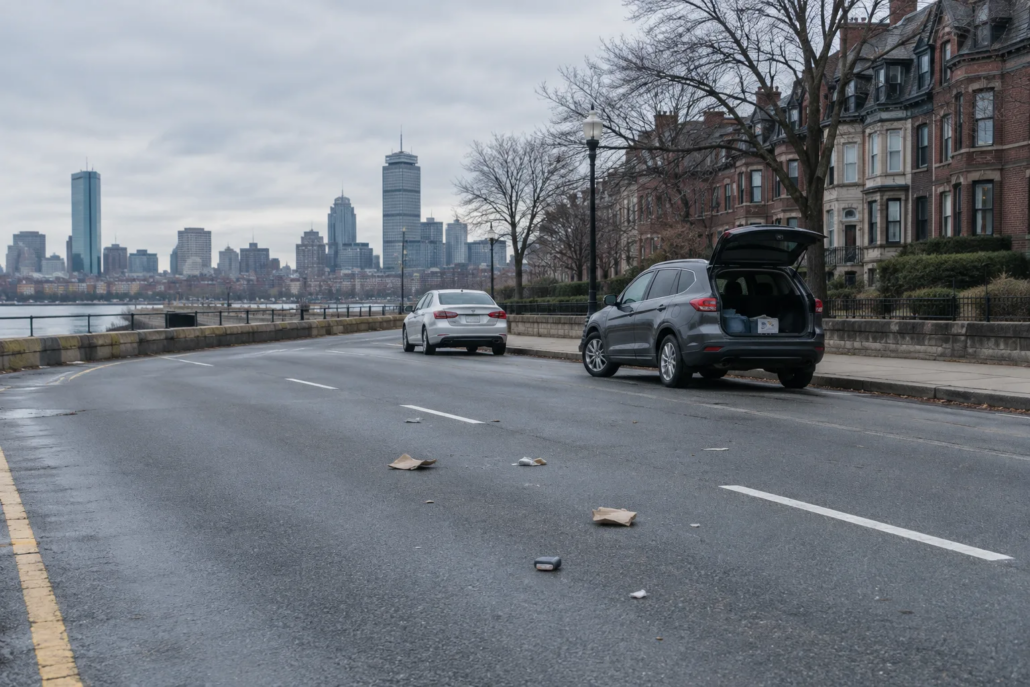
What Can Identify Who Caused a Boston Road Debris Crash?
A piece of lumber, a loose tire, or material spilling from a truck can turn an ordinary Boston drive into a sudden collision. Afterward, it may be unclear who caused the hazard—or whether anyone can be identified at all. A Boston road debris accident claim may involve more than the driver who struck the object: responsibility can depend on who dropped it, how it was loaded, and whether another party had a role in creating or addressing the danger. Neumann helps readers understand the questions an investigation may raise, without assuming that any particular person or organization is at fault. This article explains who may be responsible, what details can help identify the source, and how evidence may be preserved while the facts are still fresh.
Who may be responsible in a Boston road debris accident claim?
Responsibility depends on the object’s source and the circumstances that put it in the road. A driver who fails to secure cargo, a vehicle operator who loses a load, or a business involved in loading or transporting it may be among the parties considered. The fact that a vehicle was nearby does not, by itself, prove that its driver caused the debris or is legally responsible.
Drivers, operators, and cargo handlers
Investigators may ask whether an object fell from a car, truck, trailer, or other vehicle; whether the load was secured; and who controlled the loading or transportation. If a commercial vehicle may be involved, details about its appearance and cargo can help assess how a trucking company may share responsibility for a Boston crash. A carrier or cargo-handling business is not automatically liable; its role and the available evidence matter.
Roadwork and public vehicles
Debris may also be connected to construction activity, maintenance, or a public vehicle. The presence of a work zone alone does not establish fault, but the exact location and nearby activity may provide useful context. Photographs and other evidence from a Boston work-zone crash may help distinguish construction material from an object dropped by a passing vehicle. If a municipal or transit vehicle is a possible source, a vehicle description, witnesses, and prompt reporting can help preserve proof after a collision involving a Boston municipal vehicle.
What details can help identify the source of road debris?
Source identification can be difficult, especially when traffic moves quickly or the vehicle leaves before anyone records its details. A useful account often combines several clues rather than relying on one uncertain observation. In Boston, the precise roadway, travel direction, nearby intersection, and time of the crash can help narrow where the debris came from and whether other people or vehicles may have seen it.
Depending on the circumstances, potentially useful details include:
- Vehicle description: Make a note of the vehicle type, color, approximate size, direction of travel, and distinctive features. Avoid guessing at details you did not clearly observe.
- Cargo or object description: Record what the debris looked like, its approximate size, and where it was in the road. A photograph may help document it if the scene is safe.
- Scene photographs: Images of the object, vehicle damage, roadway, and surrounding area may help show the positions and conditions after the crash. Do not put yourself or others in danger to take them.
- Witness information: Names and contact details, if voluntarily provided, may help an investigator follow up with people who saw the object fall or the crash occur.
- Location and timing: Note the street, direction, nearby landmarks or intersections, and approximate time. These details can help identify possible cameras, work activity, or vehicle routes.
If a vehicle leaves after material falls from it, record what you can as soon as reasonably possible. Prompt reporting may help preserve details while memories are fresh; reporting an unidentified driver after a Boston hit-and-run can raise related questions about documenting an unknown vehicle and available insurance options. Do not follow a suspected vehicle or take risks to obtain information.
What should you consider when the source is uncertain?
A crash scene may not reveal who introduced the hazard. The object could have been on the roadway for some time, and a damaged car may help show how the impact occurred without identifying who left the debris. If the vehicle was struck, photographs and other records may be useful before repairs or disposal change its condition. Information about preserving a damaged vehicle after a Massachusetts car accident may help explain why documenting damage promptly can matter.
It is also important to distinguish a movable object from a defect in the road surface. A fallen load or dropped item may point toward a vehicle, cargo, or work activity; a pothole or damaged pavement raises different questions about road maintenance. The physical conditions can sometimes be confusing, so how a Boston pothole claim differs from a debris crash may be relevant when the hazard’s nature is unclear.
For a collision in Boston, keep a factual record of what you observed and when you reported it. Do not assume that a particular driver, contractor, or public entity is responsible simply because it was nearby. Claims involving public entities may have special rules under Massachusetts law, and the applicable requirements depend on the circumstances. An attorney can evaluate what evidence may be available and whether different parties or insurance policies need to be considered.
Frequently Asked Questions
Can I make a claim if I never saw what vehicle dropped the debris?
Possibly. Not seeing the object fall does not necessarily resolve whether a claim may exist, but identifying a responsible party can be harder. Photographs, witness accounts, vehicle damage, nearby work activity, and prompt reports may help establish what happened. The available evidence and any applicable insurance coverage matter, so an attorney can assess the circumstances without assuming that a particular source can be proven.
Could more than one party share responsibility for an unsecured load?
Potentially. Depending on the facts, questions may arise about the driver, vehicle operator, carrier, or someone involved in loading or securing the cargo. Their responsibilities are not identical, and a business’s involvement alone does not establish liability. The evidence may need to show who controlled the relevant task and whether that conduct contributed to the debris hazard and resulting crash.
What if I only noticed the debris after the collision?
That can happen, particularly when an object is difficult to see or traffic conditions leave little time to react. A later observation may still be relevant, but it is useful to distinguish what you personally saw from what you learned afterward. Scene photographs, vehicle damage, witness information, and a clear timeline may help explain the sequence of events and support a more complete investigation.
Can road debris cause a claim against a public entity?
It may raise questions about a public entity if the evidence connects the hazard to a public vehicle, roadwork, or another government-related activity. That connection should not be assumed merely because the crash happened on a public road. Massachusetts claims involving public entities may have special requirements, so the circumstances and applicable rules should be reviewed by an attorney familiar with the relevant jurisdiction.
How Neumann Can Help
Neumann is dedicated to helping people understand the issues that can arise after a motor vehicle collision involving road debris. A careful review may consider the object, vehicle damage, witness accounts, location, reporting history, and possible links to cargo handling, roadwork, or a public vehicle. The facts determine which questions are relevant; no single detail guarantees a particular result. Contact Neumann to request a free consultation and discuss whether an evaluation of your situation may be helpful.
The information in this article is for educational purposes only and does not constitute legal advice. Contact a qualified attorney authorized to practice in the jurisdiction that applies to your matter for advice specific to your situation.


Leave a Reply
Want to join the discussion?Feel free to contribute!