Need a Boston Construction Zone Car Accident Lawyer?
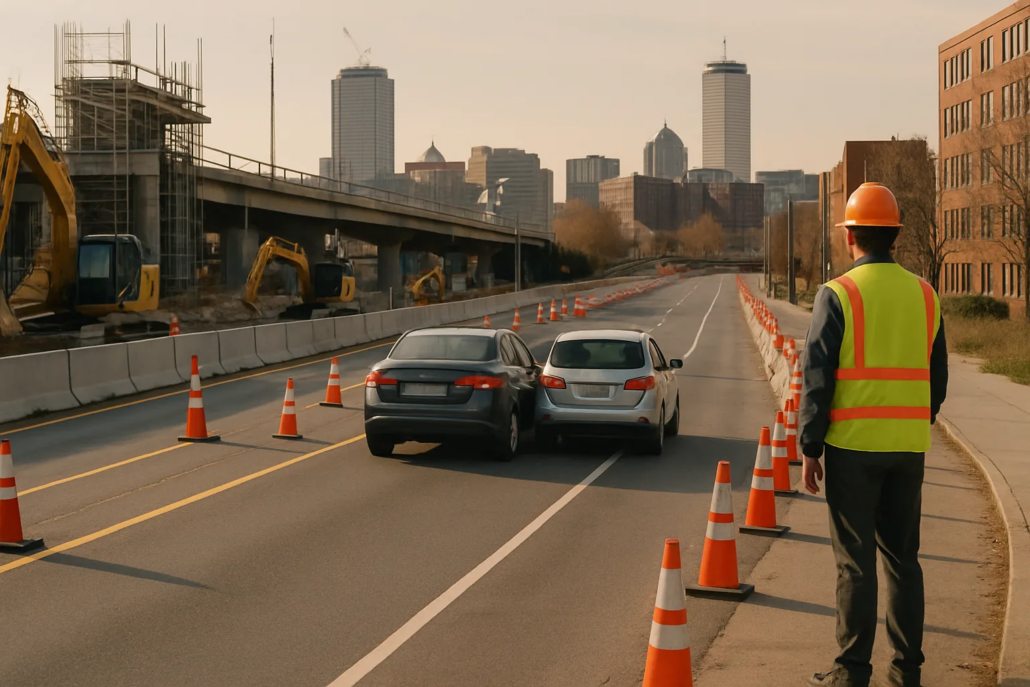
A lane suddenly narrows. Orange barrels move traffic into an unfamiliar pattern. A driver brakes, a vehicle merges, or a road worker steps into an active work area—and a collision follows. For injured drivers, passengers, and workers, understanding how a Boston work-zone crash can raise both traffic and construction issues is important from the start.
A work-zone collision is not always evaluated like a typical Massachusetts motor vehicle accident. Investigators may need to examine driver conduct, temporary signs, lane markings, lighting, traffic-control devices, roadway design, contractor practices, and the actions of more than one employer or project participant. Neumann helps readers understand the issues that may require attention without assuming who is responsible.
This guide explains what evidence may matter, how traffic and construction questions can overlap, and which mistakes may make later investigation more difficult. It is general information for Boston-area readers—not a determination of liability in any particular crash.
Why a Boston Construction Zone Car Accident Can Involve More Than Traffic Rules
A work zone changes the normal road environment. Lanes may be shifted, shoulders closed, pavement uneven, and familiar sightlines limited. Temporary traffic controls can also change as a project progresses. A driver’s speed, attention, following distance, or lane position may be reviewed, but that may be only one part of the investigation.
In Boston, Massachusetts, a collision near a bridge project, utility excavation, resurfacing operation, or major roadway improvement may involve records held by public agencies, private contractors, subcontractors, and employers. The relevant questions can include whether warnings were visible, whether a merge pattern was reasonably clear, and whether equipment or materials obstructed a driver’s view.
Driver conduct and changing lane patterns
Drivers generally remain responsible for operating with reasonable care and following applicable Massachusetts traffic requirements. Yet a confusing or unexpected lane shift may be relevant context. Photographs showing the approach to the work zone—not only the damaged vehicles—can help preserve information about visibility, spacing, and the path vehicles were expected to follow.
Construction conditions and temporary controls
A work-zone review may also consider barriers, cones, arrow boards, flaggers, lighting, pavement transitions, and the timing of traffic changes. Those facts do not automatically establish negligence. They may, however, help an attorney determine which records and witnesses should be located before conditions change.
What Evidence May Support a Massachusetts Work Zone Crash Claim?
The scene of a construction-zone crash can change quickly. Barrels may be moved, signs removed, pavement repaired, and traffic patterns reset. If a person is physically able and it is safe to do so, preserving basic information promptly may help an investigation. Emergency care and safety take priority over collecting evidence.
Potentially useful information may include:
- Wide photographs of the approach, lane shifts, barriers, signs, lighting, and roadway surface.
- Images of vehicle positions and damage from several angles, without entering an unsafe traffic area.
- The date, approximate time, weather, visibility, traffic volume, and whether darkness, glare, rain, or spray affected what could be seen.
- Names and contact information for witnesses, responding officers, flaggers, supervisors, or other people who observed the conditions.
- Insurance, employer, vehicle, and project information exchanged after the collision.
- Medical records and appointment information that document evaluation and follow-up, without attempting to self-diagnose an injury.
Preserving employer and project information
A road worker may have additional information about the employer, general contractor, subcontractors, work assignment, project location, shift, and equipment involved. A driver or passenger may receive information about the construction company or public project from an incident report or witness. These details can be important because different entities may control different parts of a work zone.
In Boston, Massachusetts, project information may also relate to MassDOT, the City of Boston, a utility, or a private developer, depending on the location and work being performed. Identifying the project does not by itself establish that an agency or contractor is legally responsible. It can help direct requests for plans, inspection materials, traffic-control records, video, and incident documentation.
How Traffic and Construction Claims Are Evaluated After a Crash
A construction traffic control injury claim may involve several legal and practical questions. An attorney may examine whether a person or entity owed a duty of reasonable care, whether conduct or conditions fell below that standard, whether the issue contributed to the collision, and what injuries and losses are being claimed. Massachusetts law governs a claim arising in the Commonwealth, while the details can vary based on the parties and circumstances.
A road worker’s situation may differ from that of a driver or passenger. Workers’ compensation may be relevant when an injury arises out of employment, while a separate claim against another potentially responsible party may sometimes be considered. The availability and interaction of claims depend on facts such as employment relationships, insurance, project control, and the source of the alleged hazard.
Common mistakes that can complicate investigation
People often focus only on vehicle damage and overlook the work-zone setting. Other problems may include:
- Failing to record the original lane pattern. A later photograph may not show what drivers saw immediately before the collision.
- Assuming the police report answers every liability question. An accident report can be useful, but it may not contain project plans, contractor records, or a complete account of temporary controls.
- Discussing fault before the facts are developed. Statements made at the scene or online may omit important details about visibility, signage, or road conditions.
- Delaying medical evaluation or documentation. A person may have symptoms that require professional assessment, and an attorney may need to understand the timing of care when evaluating a claim.
- Discarding communications or work records. Employer notices, incident forms, schedules, photographs, and messages may help establish when and where the event occurred.
A Boston construction zone car accident lawyer may also assess notice requirements, governmental-entity issues, insurance coverage, and applicable filing deadlines. These rules can be fact-specific and may differ from ordinary private-vehicle claims, so Massachusetts readers may benefit from prompt, jurisdiction-specific legal guidance.
Frequently Asked Questions
Can a driver be partly responsible for a Boston work-zone crash?
Possibly. Massachusetts may evaluate the conduct of multiple parties when the evidence supports more than one contributing factor. Speed, attention, following distance, merging, and compliance with traffic controls may be examined alongside signage, lane design, visibility, barriers, and contractor practices. Whether any party bears legal responsibility depends on the facts and applicable law. A preliminary account should not be treated as a final allocation of fault.
What if the construction company was not at the crash scene?
The absence of a contractor or supervisor at the scene does not necessarily resolve whether project-related evidence exists. Work schedules, traffic-control plans, inspection records, maintenance logs, surveillance video, and subcontractor information may be held elsewhere. A road construction accident attorney in Boston may investigate which entities worked at the location and who controlled the relevant condition. Access to those materials can depend on formal requests and the circumstances of the claim.
Does workers’ compensation apply when a road worker is injured?
Workers’ compensation may apply when a Massachusetts employee is injured in the course of employment, but coverage and available claims depend on the employment and accident facts. A worker may also have questions about a potential claim involving a third party, such as a motorist or another project participant. Because these systems can interact, a licensed Massachusetts attorney can explain the options that may fit the worker’s circumstances.
What information should a passenger preserve after a work-zone collision?
A passenger may preserve photographs, messages, medical paperwork, witness details, ride information, and a personal account of what was visible before impact. Notes can include traffic direction, lane position, lighting, weather, and whether temporary signs or barriers were easy to see. Information should be recorded accurately and kept in its original form when possible. A passenger should avoid guessing about fault or making public statements before receiving guidance specific to the situation.
How Neumann Can Help
Neumann is dedicated to helping injured drivers, passengers, and road workers understand the issues that may arise after a construction-zone collision. The firm can review the available account, identify questions involving traffic controls and project conditions, and consider what records or witnesses may require follow-up. That review may include vehicle evidence, medical documentation, employer information, insurance issues, and the roles of contractors or public entities.
Neumann is committed to fighting for clients’ rights while recognizing that every Massachusetts injury claim depends on its own facts. If you were injured in or around a Boston work zone, contact Neumann for a free consultation or case evaluation to discuss your situation and legal options.
The information in this article is for educational purposes only and does not constitute legal advice. Contact a qualified attorney licensed in Boston; Massachusetts for advice specific to your situation.


Leave a Reply
Want to join the discussion?Feel free to contribute!