
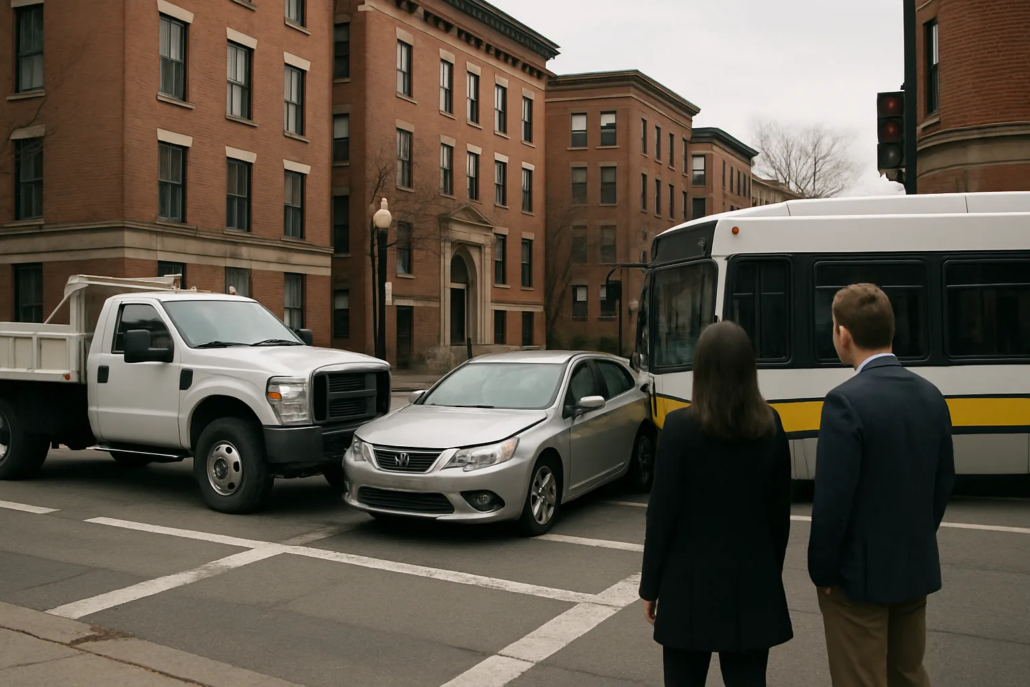
Where Can a Boston Municipal Vehicle Lawyer Find Proof?
A crash with a city truck, state vehicle, MBTA bus, or other public vehicle can create questions that do not arise in an ordinary collision. Who owns the vehicle? Which agency employs the driver? Was the vehicle operated by a contractor? Are onboard cameras, dispatch records, or traffic-camera footage likely to exist?
Those questions can affect the investigation from the beginning. If you are searching for a Boston government vehicle accident lawyer, Neumann can help you understand the issues that may need attention. This overview also explains Massachusetts car accidents involving government employees, including ownership, agency involvement, evidence preservation, and possible notice requirements.
A public entity’s involvement does not automatically establish fault or guarantee compensation. However, public-vehicle collisions may involve governmental claim procedures, special records, multiple potentially responsible parties, and evidence controlled by an agency. The sections below discuss what may change, what records can matter, and why prompt legal guidance can be important in Boston and elsewhere in Massachusetts.
Why a Boston Government Vehicle Accident Lawyer May Need to Investigate Differently
An ordinary crash investigation often begins with the drivers, insurers, vehicles, witnesses, and police report. A public-vehicle collision may require those same steps plus an examination of the government agency or transportation authority connected to the vehicle. The correct defendant or claim recipient cannot always be identified from the vehicle’s appearance alone.
Identify the vehicle owner, operator, and agency
A vehicle involved in a city vehicle crash in Boston might belong to the City of Boston, the Commonwealth of Massachusetts, the MBTA, another public authority, or a private contractor working for a public entity. Ownership, maintenance responsibility, and employment status may be separate issues. A bus, street-maintenance truck, police vehicle, or utility vehicle may also be governed by different internal policies and record systems.
Investigators may need to determine:
- The registered owner and custodian of the vehicle.
- Whether the driver was an employee, temporary worker, or contractor.
- The driver’s assignment, route, dispatch instructions, and work status.
- Which entity maintained the vehicle and controlled relevant records.
- Whether another motorist, roadway condition, signal, or vehicle defect contributed.
These details can affect the legal theory, available insurance or self-insurance, and the correct notice process. They also help prevent an injured person from assuming that the most visible agency is necessarily the only potentially responsible party.
What Evidence Matters in a Massachusetts Public Vehicle Accident Claim?
Public agencies and transit systems may possess evidence that is not available in a typical private-car collision. Depending on the vehicle and location, potentially relevant material could include onboard camera footage, exterior camera recordings, GPS or vehicle data, radio communications, dispatch records, maintenance files, operator statements, and incident reports. Some information may be retained under routine policies, while other material may require a specific preservation request.
Preserve video and incident records promptly
A person injured by an MBTA bus, municipal truck, or state vehicle may not know which cameras captured the event. Nearby businesses, buildings, intersections, and transit facilities may also have recordings. Footage can be overwritten, deleted, or become difficult to retrieve as time passes. Witness names, photographs, medical records, and the injured person’s own account can also become harder to organize later.
Practical preservation issues may include:
- Photographing the scene, vehicle positions, visible damage, traffic controls, lighting, and roadway conditions when reasonably possible.
- Recording witness names and contact information without pressuring anyone about what they should say.
- Keeping copies of police, transit, ambulance, and agency incident information received by the injured person.
- Asking an attorney to evaluate whether preservation requests should be sent to agencies, transportation authorities, contractors, or nearby businesses.
- Avoiding repairs, disposal, or destructive inspection of a vehicle before considering preserving the damaged vehicle after a Massachusetts crash.
A preservation request does not guarantee that evidence exists or will be produced. It can, however, identify the types of records that may be relevant before routine retention practices affect them. More examples of time-sensitive material appear in this guide to evidence to save after a Boston pedestrian collision.
How Fault, Notice, and Immediate Benefits May Differ in Boston
Public ownership does not mean an agency is automatically liable. Massachusetts law generally requires an evaluation of duty, unreasonable conduct or another recognized basis for liability, causation, and damages. The analysis may involve the operator’s conduct, traffic-signal timing, visibility, route conditions, vehicle maintenance, training, and competing accounts of how the collision occurred. Readers can review a general explanation of how Massachusetts determines fault in a motor vehicle accident.
Government claim procedures and deadlines
A claim involving a Massachusetts public entity may be subject to rules that differ from a private-insurer claim. Depending on the entity and circumstances, a person may need to provide information or present a claim to the proper public body before pursuing litigation. Governmental immunity principles, statutory exceptions, notice requirements, and filing deadlines can all be important. The specific requirements may depend on whether the responsible entity is the City of Boston, the Commonwealth, the MBTA, or another authority.
An agency investigation or settlement conversation does not necessarily preserve every legal deadline. Promptly reviewing Boston car accident claim filing deadlines with a qualified Massachusetts attorney may help identify issues that cannot safely be postponed.
Medical bills and wage loss
Available no-fault benefits may help address eligible medical expenses or lost wages while responsibility is investigated. Depending on the circumstances, Massachusetts PIP benefits after a Boston collision may be relevant. PIP does not decide who caused the crash or resolve a separate claim against a public entity. Keeping bills, wage-loss records, insurer correspondence, and claim documents can help organize the financial picture.
Frequently Asked Questions
Does an MBTA bus passenger have a different type of injury claim?
Possibly. A passenger’s claim may involve the bus operator, the MBTA, another public entity, or a contractor, depending on the facts. The circumstances of the event—such as sudden braking, a collision, or a fall while boarding—can affect the investigation. Medical documentation, route and incident records, witness accounts, and applicable public-entity procedures may all matter. A Massachusetts attorney can assess the specific facts and identify potential claim requirements.
Can I make a claim if the public vehicle driver was not ticketed?
A ticket or criminal charge is not required for every civil injury claim, and the absence of a citation does not by itself resolve fault. Civil responsibility may depend on evidence such as video, witness statements, vehicle data, traffic controls, and medical records. Conversely, a citation does not automatically prove every element of a civil case. The available evidence and applicable Massachusetts rules should be evaluated together.
What if a private contractor operated the government vehicle?
A contractor may be a separate potential party, but that cannot be assumed from the vehicle’s markings or assignment. The investigation may need to identify the vehicle owner, contracting agency, employer, insurer, maintenance provider, and driver’s work status. Different entities may have different records and notice provisions. Prompt investigation can help clarify whether the claim involves a public entity, a private company, or both.
Can I still pursue compensation if I used my own insurance first?
Using available insurance benefits does not necessarily determine responsibility for the collision. Depending on the policy and circumstances, PIP or other first-party benefits may address certain eligible expenses while a liability investigation continues. Insurer communications, medical bills, wage-loss documents, and payment records should be retained. Because coverage and reimbursement issues vary, a lawyer can explain how those benefits may interact with a potential public-vehicle claim. For additional context on this issue, see Commercial Vehicle Versus Personal Coverage.
How Neumann Can Help
Neumann is dedicated to helping injured people understand the additional questions that can arise when a Boston collision involves a municipal, state, or transit vehicle. The firm can review available reports, identify the vehicle owner and potentially responsible entities, consider evidence-preservation concerns, and evaluate notice, deadline, insurance, and PIP issues under Massachusetts law.
A public-vehicle case may require coordination of agency records, video sources, vehicle evidence, medical documentation, and witness information. Neumann is committed to fighting for clients’ rights while providing a realistic assessment of their legal options. Contact Neumann for a free consultation or case evaluation about your collision.
The information in this article is for educational purposes only and does not constitute legal advice. Contact a qualified attorney licensed in Boston for advice specific to your situation.

Leave a Reply
Want to join the discussion?Feel free to contribute!