
Why Are Boston Chain-Reaction Crash Claims So Complex?
A sudden stop on a Boston roadway can create several impacts in only a few seconds. One vehicle may strike the car ahead, a following driver may collide with that vehicle, and another impact may occur before anyone can safely move out of the traffic lane. For someone injured in that sequence, finding a Boston chain reaction accident lawyer is only one part of understanding what may happen next.
Chain-reaction claims are difficult because the evidence must explain not only that a crash occurred, but also how each impact contributed to each injury and loss. Several drivers may give different accounts. Damage may be repaired before it is fully documented. Multiple insurance companies may investigate the same event from different perspectives. Neumann provides guidance on the practical issues that can matter, including preserving photographs, witness information, vehicle positions, medical records, and policy details.
This guide explains how to protect useful evidence, how responsibility may be evaluated under Massachusetts law, how insurance coverage may work while fault remains disputed, and which mistakes can make a multi-car accident claim in Massachusetts harder to assess.
Why Boston Chain-Reaction Accident Claims Require Detailed Evidence
In a two-vehicle collision, the basic impact may appear relatively clear. A chain reaction is different. The first collision can change the position of several vehicles, create a second hazard, and affect how later drivers respond. A damaged bumper or twisted frame may show that contact occurred, but it may not establish which impact caused a particular symptom or property loss.
Preserve the vehicles and their positions
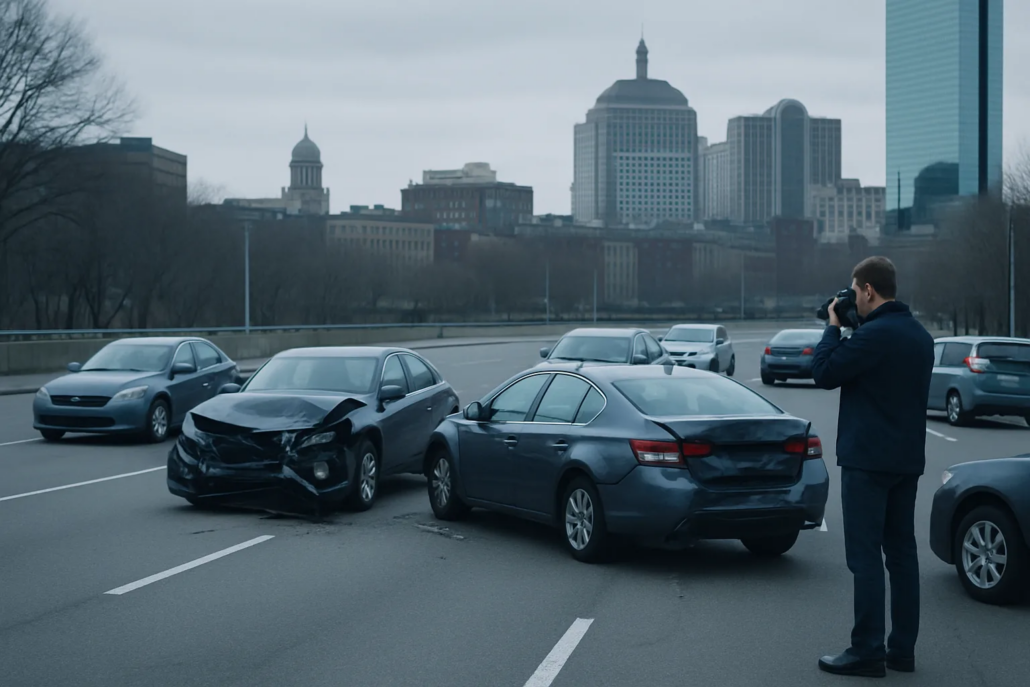
When it is safe and lawful to do so, photographs should show the vehicles, roadway, lane positions, traffic controls, weather, lighting, and visible debris. Images taken before vehicles are moved can help preserve the physical setting. Each driver should also exchange identifying and insurance information, while avoiding speculation about fault at the scene.
Evidence can disappear quickly when vehicles are towed, cleaned, repaired, or sold. The practical guidance on preserving a damaged vehicle after a Boston crash explains why photographs, inspection records, repair estimates, and other vehicle information may matter when the impact sequence is contested.
Gather witness and scene information
Witnesses may remember the order of impacts, traffic conditions, a vehicle’s speed, or whether a driver had time to stop. Useful details include names, phone numbers, statements made at the scene, and the location where each witness was standing or traveling. Police reports may help organize the investigation, but they are not always a complete reconstruction of every impact.
In Boston, roadway design and traffic density can make a precise timeline especially important. A claim may involve vehicles stopped near an intersection, merging traffic, construction activity, or limited visibility. Photographs and witness details should be preserved promptly rather than relying on memory to fill gaps later.
How Liability and Insurance Are Evaluated in a Multi-Car Crash
A central question is often: who is liable in a chain reaction crash? The answer depends on the facts, including following distance, speed, attentiveness, roadway conditions, traffic signals, and each driver’s response to the initial impact. The driver who caused the first collision may not be the only person whose conduct contributed to later impacts.
Reconstructing the impact sequence
Investigators and insurers may compare:
- Vehicle positions and final resting locations
- Damage alignment, crush patterns, and contact points
- Skid marks, debris, roadway grade, and visibility
- Driver and witness statements
- Traffic signals, signs, and lane movements
- Available photographs, video, or vehicle data
This type of review is part of broader Massachusetts fault determinations for motor vehicle accidents. A disagreement about the sequence can affect which driver is considered responsible for a specific impact and whether one injury resulted from one collision or several successive forces.
Several drivers may share responsibility
Massachusetts negligence claims may involve more than one responsible party. Depending on the evidence, responsibility could be assigned among a driver who initiated the event, a driver who followed too closely, or another person whose conduct contributed to the collision. Massachusetts comparative negligence principles can also affect recovery when an injured person’s own conduct is alleged to have contributed to the harm. The application of those principles depends on the facts and the type of claim.
A discussion of joint liability in Massachusetts negligence claims may help explain why identifying every potentially responsible party matters. A claimant generally should not assume that the first driver named in a report is automatically responsible for every injury or loss.
Identify every possible source of insurance
A chain-reaction crash can involve several liability policies, different claim representatives, and competing accounts of responsibility. Keep copies of insurance cards, policy correspondence, claim numbers, photographs, repair estimates, and recorded-statement requests. Do not assume that one insurer’s position resolves the coverage issues for all involved vehicles.
Massachusetts personal injury protection, or PIP, may help with eligible medical expenses and lost wages while a liability investigation continues. Information about Massachusetts PIP benefits after a Boston collision explains why this coverage can be relevant before fault is fully decided. If a driver is unidentified, uninsured, or does not have enough coverage, Massachusetts uninsured motorist claims in Boston may also be worth discussing with a qualified attorney.
What Should You Document After a Boston Pileup Accident?
People often focus on vehicle damage and overlook medical records, changing symptoms, lost income, and future care. That omission can make a pileup accident injury claim in Boston harder to evaluate, particularly when several impacts make it difficult to identify which event caused a particular condition.
Preserve medical records and changing symptoms
Seek appropriate medical attention based on your circumstances and keep records of appointments, diagnoses, treatment plans, work restrictions, prescriptions, and referrals. A symptom journal can help record when pain, dizziness, headaches, weakness, or other symptoms appear and how they affect ordinary activities. It should describe observations rather than attempt to provide a medical diagnosis.
Emergency department records, follow-up notes, and witness observations may be important when symptoms develop gradually. The discussion of concussion records after a Boston crash offers additional context about documenting symptoms that may not be obvious immediately after a collision.
Track ongoing losses and future care
Keep wage statements, work-absence records, transportation costs, invoices, and correspondence concerning property damage. If medical providers identify possible future treatment, rehabilitation, medication, procedures, or assistive equipment, retain the relevant care plans and recommendations. Records supporting future care costs after a Boston crash may become important when the effects of an injury are expected to continue.
Avoid common evidence mistakes
Several preventable actions can complicate a claim:
- Posting statements or photographs about the crash or recovery on social media
- Giving a recorded statement before understanding what is being asked
- Guessing about speed, impact order, or fault
- Repairing or disposing of a vehicle before documenting its condition
- Failing to report changing symptoms to a medical provider
- Assuming an insurer’s initial decision is the final word on responsibility
These issues do not automatically determine the outcome of a claim. They can, however, create disputes about credibility, causation, or the amount of loss. In Boston and elsewhere in Massachusetts, legal deadlines may also apply even while symptoms, coverage, and responsibility remain under investigation. Review Boston car accident filing deadlines promptly because deadlines can vary by claim type, party, and circumstance, and laws may change.
Frequently Asked Questions
Is the driver who caused the first impact always responsible for the entire chain-reaction crash?
Not necessarily. The first driver may have contributed to the event, but later drivers may also bear responsibility if their conduct caused additional impacts or worsened the harm. Investigators may review speed, following distance, visibility, traffic conditions, vehicle positions, and damage patterns. Massachusetts comparative negligence rules may affect how responsibility is evaluated, so the answer depends on the evidence in the particular crash.
What photographs are most useful after a multi-vehicle collision?
Photographs can show each vehicle from several angles, close views of damage, debris, skid marks, lane positions, traffic controls, weather, lighting, and surrounding road conditions. If vehicles have not yet been moved and it is safe to take pictures, wider scene images may help establish their positions. Preserve original files when possible and avoid editing images in a way that removes timing or location information.
Can I pursue a claim if I do not know which impact caused my injury?
Possibly, but medical and crash evidence becomes especially important. Emergency records, follow-up notes, symptom timing, witness observations, vehicle damage, and expert opinions may help evaluate causation. A person should not attempt to diagnose the source of an injury independently. A qualified attorney can review the available facts and explain how uncertainty about successive impacts may affect the claim.
What if one of the drivers has no insurance or leaves the scene?
The answer may involve your own policy, including uninsured or underinsured motorist coverage, depending on the circumstances and policy terms. Preserve information about the vehicle, witnesses, police report, medical treatment, and insurance communications. Massachusetts requirements and policy provisions can affect the analysis. Because unidentified or uninsured drivers create additional procedural and coverage questions, prompt legal review may be useful.
How Neumann Can Help
Neumann is dedicated to helping injured people understand the evidence and insurance issues that can arise after a multi-vehicle collision. The firm can review photographs, witness information, vehicle records, medical documentation, lost-income materials, and communications from insurers to help assess the available legal options.
A Boston chain reaction accident lawyer may also help organize the impact sequence, identify potentially responsible parties, and communicate with multiple insurers while preserving relevant evidence. Neumann is committed to fighting for clients’ rights and is ready to evaluate your situation. Contact the firm for a free consultation or case evaluation.
The information in this article is for educational purposes only and does not constitute legal advice. Contact a qualified attorney licensed in Boston for advice specific to your situation.


Leave a Reply
Want to join the discussion?Feel free to contribute!