How Do Lot Signs Help a Boston Parking Accident Lawyer?
A low-speed crash in a parking garage may seem less serious than a collision on a Boston street. Yet a vehicle can still cause significant injuries in a garage, shopping-center lot, apartment driveway, or private access road. The setting may also determine what evidence is available and how investigators reconstruct what happened.
For someone searching for a Boston parking lot accident lawyer, the central question is not simply whether the collision occurred off public property. Massachusetts negligence principles may still apply, but private-property crashes often involve unusual traffic patterns, unclear right-of-way rules, property design, surveillance systems, and disputed accounts. Neumann helps injured people understand those issues without assuming that every case follows the same path.
This guide explains how fault may be evaluated, what drivers, passengers, pedestrians, and cyclists should document, how insurance may respond, and which mistakes can make evidence harder to preserve. Laws and procedures can vary by location and may change, so case-specific advice requires review by a Massachusetts-licensed attorney.
How Is a Boston Parking Lot Accident Handled Differently From a Street Crash?
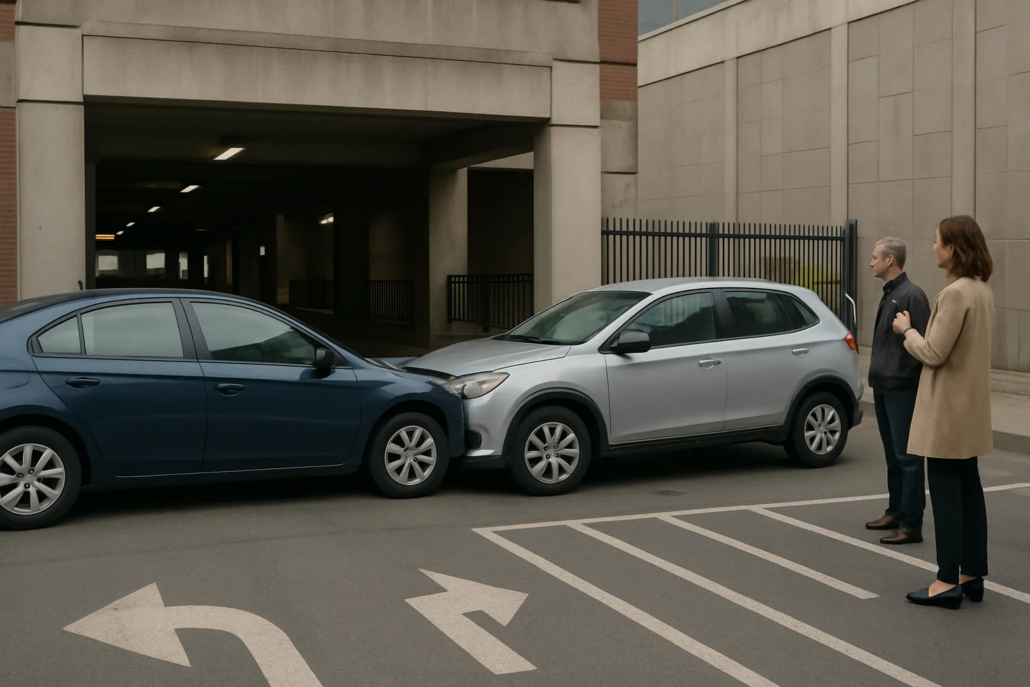
A public street usually has established lanes, traffic signals, crosswalks, and posted speed limits. A private lot may have some of those features, but it may also contain one-way arrows, stop signs, loading areas, parking aisles, ramps, reversing vehicles, and pedestrians moving between parked cars. A garage may add poor lighting, tight turns, pillars, gates, and cameras operated by a property manager.
The absence of a conventional public roadway does not automatically eliminate a driver’s duty to use reasonable care. The investigation may instead focus on what a reasonably careful driver should have seen and done in that specific environment. For an overview of the broader principles, see Massachusetts standards for determining motor-vehicle accident fault.
Details that may affect fault
Important questions can include:
- Was a driver moving through a marked lane, an unmarked aisle, or a ramp?
- Did a stop sign, yield sign, directional arrow, or painted line control the movement?
- Was a vehicle pulling forward, backing out, turning, or already established in the travel path?
- Did lighting, landscaping, parked vehicles, columns, or a blind driveway limit visibility?
- Did a property condition contribute to the event, or was the primary issue driver conduct?
These facts may matter in a Massachusetts parking lot car accident fault analysis. Comparative responsibility may also become an issue if more than one person or condition contributed to the collision.
What Should You Document After a Private-Property Vehicle Accident in Boston?
Evidence can change quickly after a parking-lot collision. Vehicles are moved, security footage may be overwritten, temporary signs may be removed, and weather or lighting conditions may differ by the time an insurer or attorney investigates. If it is safe to do so, photographs and notes made soon after the event can provide useful context.
Record the scene and vehicles
Photograph the approach to the crash from several directions, including lane markings, stop or yield signs, arrows, curbs, crosswalks, ramps, lighting, obstructions, and the positions of the vehicles. Capture wide views as well as close images of damage, tire marks, broken parts, and nearby structures. Do not put yourself or anyone else in danger to obtain a photograph.
Also consider preserving a damaged vehicle after a Massachusetts crash. Before repairs or disposal when reasonably possible, retain photographs, repair estimates, towing records, inspection documents, and information about deployed safety systems or onboard data. An attorney can help assess what physical evidence may be important in a particular case.
Document people, surveillance, and special road users
Obtain names and contact information for witnesses, employees, security personnel, and property representatives when available. Note the exact location, approximate time, weather, lighting, and what each person observed without pressuring anyone to adopt a particular version of events.
Pedestrians should photograph sidewalks, curbs, crosswalks, obstructions, clothing, and visible property damage when safe. These evidence Boston pedestrians should save after a collision may be especially important in garages and shopping-center lots. Cyclists should document bicycle damage, helmet damage, travel position, parked-vehicle spacing, door position, and visibility. Evidence in a Boston cyclist dooring collision can be disputed when a vehicle door, access lane, or parked-car arrangement obscures what happened.
Ask the property owner, manager, security office, or nearby business how to submit a prompt request to preserve relevant footage. A request does not guarantee that video exists or will be released, but identifying cameras and the likely retention period can help an attorney evaluate preservation options.
What Insurance and Claim Issues Follow a Parking-Lot Collision?
A private-property setting does not by itself answer which insurance coverage applies or who may be legally responsible. The facts may involve one or more drivers, a vehicle owner, an employer, a property owner, a maintenance contractor, or another responsible party. Those possibilities should be evaluated carefully rather than assumed from the location alone.
In Massachusetts, personal injury protection, commonly called PIP, may provide certain benefits regardless of who caused a motor-vehicle collision, subject to policy terms and legal requirements. For general information, review Massachusetts PIP benefits after a Boston collision. Injured people may also need to keep medical records, wage-loss documentation, receipts, claim correspondence, and photographs together while fault is investigated.
When the other driver leaves or lacks adequate insurance
If another driver leaves before information is exchanged, report the incident through appropriate channels and record every detail available, including vehicle description, partial plate information, direction of travel, witnesses, and nearby cameras. Guidance on preserving surveillance and witness evidence after a Boston hit-and-run may be relevant.
When the responsible driver is unidentified, uninsured, or underinsured, policy language may affect available options. A person may want to review information about Boston uninsured and underinsured motorist claims with a qualified attorney and insurer. Do not assume that a garage or shopping-center lot automatically prevents a coverage claim.
Common mistakes that can complicate a claim
People sometimes make avoidable errors after a seemingly minor collision. Examples include:
- Moving vehicles before documenting their positions, when safety does not require immediate movement.
- Failing to identify the property manager or request preservation of surveillance footage.
- Giving a recorded statement or signing a release without understanding its scope.
- Delaying attention to symptoms or failing to keep records of medical visits and missed work.
- Assuming informal insurance discussions extend Boston deadlines for filing a motor-vehicle injury claim.
Depending on the parties and claims involved, deadlines can differ. Massachusetts law governs many Boston injury claims, but the applicable period may depend on the injury, defendant, governmental involvement, and type of action. Early legal review may help identify issues before evidence disappears.
Frequently Asked Questions
Does a parking-lot crash count as a motor-vehicle accident in Massachusetts?
Generally, a collision involving a motor vehicle in a parking lot, garage, driveway, or private roadway may still support an injury or property-damage claim. The location does not automatically remove ordinary duties of care. The facts matter, including vehicle movements, signs, visibility, pedestrian activity, and whether another person or property condition contributed. Insurance coverage and filing deadlines depend on the circumstances and applicable Massachusetts law.
Who may be responsible for a collision in a private parking garage?
Responsibility may rest with one driver, both drivers, or potentially another party if a property or maintenance issue contributed. A careful review may consider speeding, backing, distraction, failure to yield, poor lighting, blocked sightlines, missing signs, or defective design. Not every unsafe condition creates legal liability, and a property owner is not automatically responsible for every crash. Evidence is needed to evaluate the competing explanations.
Can security-camera footage be used in a Boston parking-lot claim?
Potentially. Footage may show vehicle movements, timing, lighting, pedestrian activity, signs, or what happened immediately before and after impact. Cameras may be controlled by a garage operator, store, apartment complex, or security company, and recordings may have limited retention periods. A prompt preservation request can identify the footage and reduce the risk that relevant material is overwritten, although access and admissibility depend on the circumstances.
What if I was a passenger, pedestrian, or cyclist rather than a driver?
The same crash may affect several injured people, each with different evidence and insurance issues. Passengers should record the vehicles involved and witness information. Pedestrians and cyclists should document their location, markings, visibility, clothing or equipment damage, and available surveillance when safe. Because liability and coverage can differ by person, a Massachusetts attorney may help evaluate the facts without assuming that the driver’s account resolves the claim.
How Neumann Can Help
Neumann is dedicated to helping injured drivers, passengers, pedestrians, and cyclists understand the evidence and insurance issues that can arise after a private-property collision. The firm is committed to fighting for clients’ rights while examining practical details such as lane markings, signs, lighting, vehicle positions, witnesses, surveillance, medical documentation, and applicable deadlines.
A Boston parking lot accident lawyer may be able to help organize evidence, communicate with insurers, assess potential sources of responsibility, and explain available legal options. Contact Neumann for a free consultation or case evaluation to discuss what happened and what information may matter.
The information in this article is for educational purposes only and does not constitute legal advice. Contact a qualified attorney licensed in Boston for advice specific to your situation.

Leave a Reply
Want to join the discussion?Feel free to contribute!