
How Can a Boston Dooring Accident Lawyer Build Evidence?
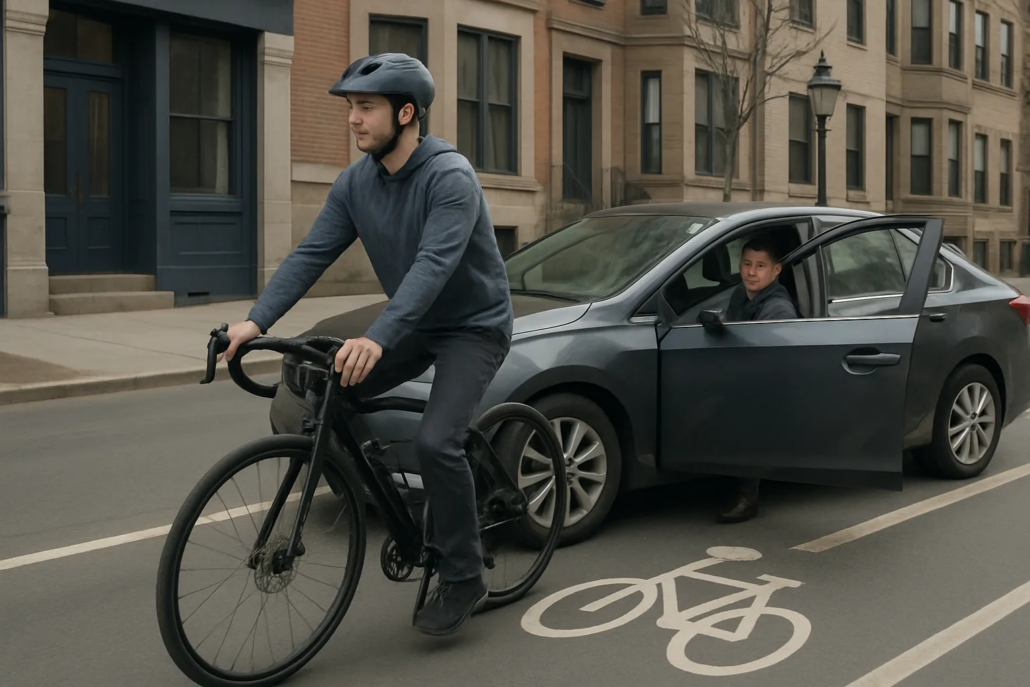
A cyclist traveling through Boston can be placed in danger within seconds when someone opens a parked vehicle door into the rider’s path. The resulting impact, often called a “dooring” crash, may throw the cyclist into traffic or onto the pavement even when the vehicle itself never moves. If you are searching for a Boston cyclist dooring accident lawyer, it is important to understand that the claim may involve more than a simple question of who had the right of way.
A dooring collision can turn on the door’s position, the location of the bike lane or travel lane, lighting, traffic conditions, witness observations, and whether nearby video captured the event. Neumann can help injured cyclists understand how these facts may be evaluated. This guide explains what makes these cases distinct, what evidence may matter, how shared-fault arguments arise, and which insurance questions may need attention.
Is a Boston Dooring Crash Treated Differently for an Injured Cyclist?
A Massachusetts bicycle dooring accident is still a motor-vehicle injury matter, but the evidence may look different from a typical moving-car collision. The driver or passenger may have been stationary, yet opening a door into a cyclist’s path can create a significant roadway hazard. Investigators may examine whether the person exiting had a reasonable opportunity to check for approaching bicycles and whether the door extended into a bike lane or the cyclist’s ordinary travel path.
Why the Door’s Position Matters
Photographs can help show whether the door was fully open, partly open, or already closing when contact occurred. They may also show the door edge, damage to the bicycle, damage to the vehicle, debris, skid marks, and the distance between the parked vehicle and the lane of travel. Conditions can change quickly after a crash, so preserving the vehicle and its crash evidence may be important before repairs or removal.
The investigation may also consider whether the vehicle was legally parked, stopped temporarily, near an intersection, or positioned beside a marked bicycle facility. A cyclist’s location at the moment of impact can be disputed, particularly on crowded Boston streets where bike lanes, parked cars, delivery activity, and opening doors may overlap.
Visibility and Lighting Conditions
Daylight, darkness, rain, glare, street lighting, and vehicle lights can affect how the parties perceived one another. A person opening a door may argue that the cyclist was difficult to see. The cyclist may point to reflective equipment, bicycle lights, a clear line of sight, or the vehicle’s position blocking visibility. These factual issues do not decide a claim automatically, but they can influence how responsibility is assessed.
What Dooring Crash Evidence Should a Boston Cyclist Preserve?
Evidence is often most useful when it captures the scene as it existed shortly after the collision. If it is safe to do so, a cyclist or witness may document:
- The parked vehicle from several angles, including the open door and door hinges.
- The bicycle, helmet, clothing, lights, reflectors, and visible impact damage.
- The bike lane, travel lane, curb, parked-car spacing, road surface, and traffic controls.
- Lighting, weather, visibility, and the direction in which the cyclist was traveling.
- Witness names and contact information, along with what each person actually observed.
- Nearby businesses, residences, transit vehicles, or other sources that may have cameras.
A person should avoid placing themselves in traffic or interfering with emergency personnel to gather photographs. The precise location, approximate time, vehicle description, and license plate may become especially important if the driver leaves before information is exchanged.
Collecting Door-Crash Evidence Before It Disappears
Video systems may overwrite footage, and witnesses may leave before their observations are recorded. Saving photographs, witness details, and nearby surveillance evidence can help preserve information that may not be available later. Potential sources include storefront cameras, residential systems, traffic cameras, dashcams, and video from buses or other vehicles, although access may depend on the owner and applicable procedures.
Medical documentation is another form of evidence. A cyclist should describe the event accurately to medical professionals and keep records of appointments, restrictions, symptoms, and related expenses. Headaches, dizziness, concentration problems, or other symptoms may appear after the initial impact. Documenting concussion symptoms after a Boston crash can be relevant when evaluating the nature and duration of an injury, without assuming a diagnosis or outcome.
Who May Be Responsible in a Massachusetts Bicycle Dooring Accident?
Responsibility depends on the facts and applicable Massachusetts law. A driver, passenger, vehicle owner, employer, or another party may become relevant in some cases, but the correct analysis requires investigating the person who opened the door, the vehicle’s use, insurance coverage, and the collision circumstances. A Boston bike lane accident should not be evaluated solely from a short description such as “the cyclist hit a door.”
A liability review may consider:
- Whether the door was opened into a lane or path where a cyclist could reasonably be traveling.
- Whether the person opening the door checked for approaching traffic and had sufficient visibility.
- Whether parking or stopping conditions narrowed the cyclist’s available route.
- Whether poor lighting, obstructions, road design, or another vehicle contributed.
- Whether the cyclist’s speed, lane position, equipment, or reaction is being raised as comparative fault.
Massachusetts generally permits fault to be divided when more than one person contributed to an injury. The effect of any assigned fault can depend on the facts and the governing law. For that reason, a driver’s claim that a cyclist was too close to parked cars does not automatically resolve a car door cyclist injury claim. How Massachusetts bicycle collisions can raise preventability and liability questions provides related context, but every collision requires its own evidence review.
Insurance Issues After a Boston Dooring Collision
The parked vehicle’s liability policy may be relevant, but it may not be the only possible source of coverage. Depending on the cyclist’s household and vehicle-insurance circumstances, personal injury protection benefits or other coverage may need to be identified promptly. Using Massachusetts PIP benefits after a Boston collision explains why coverage questions can arise even while responsibility is being investigated.
If the driver cannot be identified, leaves the scene, or lacks enough insurance, Massachusetts uninsured or underinsured motorist coverage options may warrant review. Preserving a plate number, vehicle description, police report, witness information, and video can be important to that analysis.
What Mistakes Can Weaken a Boston Dooring Claim?
Injured cyclists may be focused on pain, transportation, and replacing damaged equipment. Even so, avoidable gaps can make later evaluation more difficult. Common problems include:
- Moving or repairing the bicycle before photographing its condition.
- Failing to record the door’s position, vehicle location, or lane markings.
- Assuming a witness will contact the cyclist without obtaining contact information.
- Waiting too long to identify nearby cameras or request preservation of footage.
- Describing symptoms inconsistently or failing to attend appropriate follow-up care.
- Giving a recorded statement or signing documents before understanding the request.
These points are not instructions for a particular claim. They are general issues that may affect evidence quality. In Boston, busy streets and changing parking conditions can make a scene difficult to reconstruct after the fact. A lawyer evaluating a claim may review the police report, photographs, medical records, witness accounts, insurance policies, roadway layout, and available video together rather than relying on one fact.
Frequently Asked Questions
Does a cyclist have to be in a marked bike lane to bring a dooring claim?
No single roadway position automatically determines whether a claim exists. A cyclist may be traveling in a marked bike lane, a shared lane, or another lawful part of the roadway, depending on the circumstances. The analysis may consider traffic rules, visibility, parked-vehicle placement, and whether the door entered the cyclist’s path. A Massachusetts attorney can evaluate the specific street layout and available evidence.
What if the driver says the cyclist was moving too fast?
Speed allegations may become part of a comparative-fault argument, but they do not by themselves establish responsibility. Investigators may examine the cyclist’s speed, the distance from the vehicle, sight lines, lighting, traffic, and how much time the person opening the door had to observe the roadway. Witness statements, video, physical damage, and scene photographs may help test competing accounts.
Can a damaged bicycle be part of an injury claim?
Potentially. A claim may involve property damage as well as bodily injuries, depending on the facts, available coverage, and applicable Massachusetts law. Photographs, purchase records, repair estimates, and information about attached equipment can help document the bicycle’s condition and value. The cyclist should consider preserving the bike and related items until their evidentiary value has been evaluated.
What if the dooring crash happened near a Boston business?
A nearby business may have exterior or parking-area video, but recordings are not necessarily retained indefinitely or released automatically. The exact location, approximate time, camera direction, and name of the business may help identify potential footage. Other sources can include residences, transit vehicles, delivery vehicles, and witnesses. A lawyer may discuss appropriate preservation and evidence-request options.
How Neumann Can Help
Neumann is dedicated to helping injured cyclists understand the evidence and insurance issues that may affect a Boston dooring collision. The firm can evaluate the door’s position, roadway conditions, bike-lane or travel-lane evidence, lighting, witness information, nearby cameras, medical documentation, and potential shared-fault arguments. Neumann is committed to fighting for clients’ rights while explaining the legal process in clear terms and avoiding assumptions about the result.
If you or a family member was injured in a Massachusetts bicycle dooring accident, contact Neumann for a free consultation or case evaluation. A licensed attorney can discuss the facts, available coverage, and legal options that may apply to your situation.
The information in this article is for educational purposes only and does not constitute legal advice. Contact a qualified attorney licensed in Boston for advice specific to your situation.


Leave a Reply
Want to join the discussion?Feel free to contribute!