
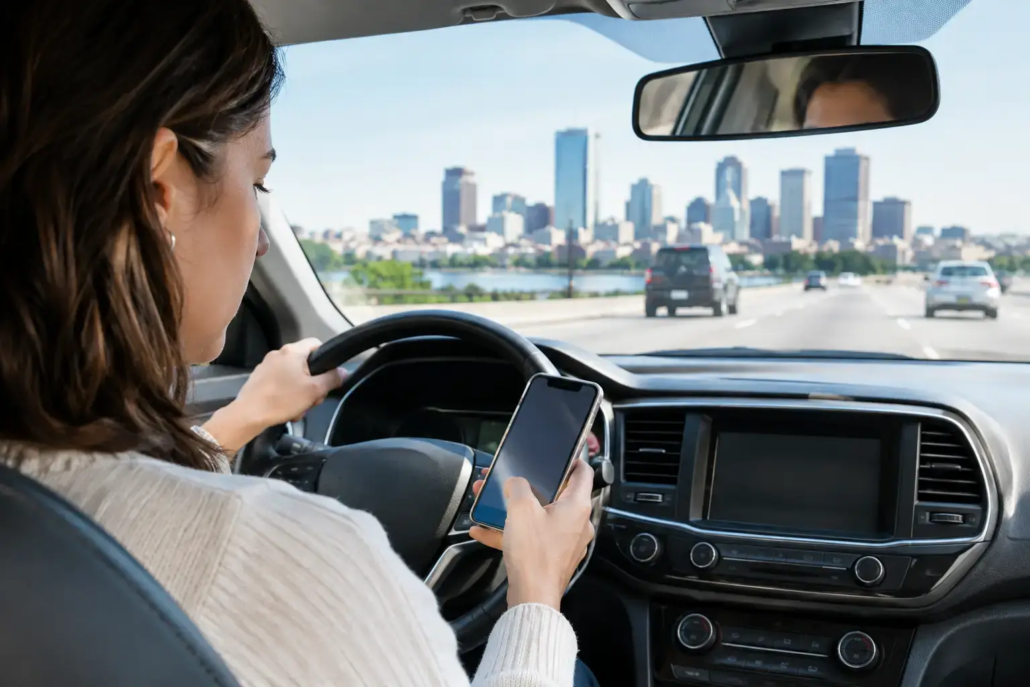
How to Identify Distracted Drivers on Massachusetts Roads
A driver does not need to be visibly texting to be distracted. On the Mass Pike, Storrow Drive, Route 128, or a crowded Boston intersection, a few seconds of inattention can be enough to miss stopped traffic, drift toward a cyclist, or enter a crosswalk without yielding. Knowing how to identify distracted drivers can help you avoid a collision and recognize evidence that may matter if one occurs.
Distracted driving cases are rarely proved by one dramatic fact. They are built from the driver’s actions before impact, the physical evidence, witness observations, vehicle data, phone records, and sometimes footage that disappears quickly. For an injured person or family, recognizing the warning signs early can make a real difference.
What Distracted Driving Looks Like From Another Vehicle
The most common sign is inconsistent vehicle control. A distracted driver may wander within a lane, cross a lane marker, brake late and abruptly, or leave an unusually large gap before moving at a green light. These behaviors can also result from fatigue, impairment, an unfamiliar road, or a mechanical problem. Still, they are reasons to create distance and drive defensively.
Watch for a driver whose attention repeatedly drops below the windshield line. They may be looking at a phone, adjusting a navigation screen, eating, reaching for something, or handling an object in the passenger seat. A driver may also turn their head toward a passenger for too long while traffic is moving.
Other warning signs include failing to respond to changing traffic conditions. For example, a driver may not notice brake lights ahead, fail to yield at a marked crosswalk, miss a lane closure, or continue through an intersection after the light has changed. In Boston and surrounding communities, where pedestrians, cyclists, delivery vehicles, rideshare traffic, and construction zones often compete for limited space, those missed cues can have serious consequences.
How to Identify Distracted Drivers Without Putting Yourself at Risk
If you see concerning driving behavior, the priority is not proving what the other driver is doing. It is protecting yourself. Increase your following distance, avoid driving beside the vehicle for long, and give the driver room to make an unexpected movement. Do not try to record the driver, gesture at them, or confront them at a light. Looking for evidence while operating your own vehicle creates another distraction.
If the behavior creates an immediate danger, a passenger can note the vehicle’s description, location, direction of travel, and license plate if it can be done safely. In an emergency, call 911 when it is safe to do so. Otherwise, pull over before reporting dangerous driving.
For pedestrians and cyclists, the same principle applies. A vehicle rolling through a stop sign, turning without checking a crosswalk, or drifting toward a bike lane may be operated by a distracted driver. Do not assume eye contact means the driver has actually seen you. Wait for the vehicle to yield and make sure there is a clear path before entering its path of travel.
Signs That Matter After a Crash
After a collision, a distracted driver may admit what happened without realizing the legal importance of the statement. They might say, “I did not see you,” “I was looking at my GPS,” or “I only looked down for a second.” If you are able, write down the exact words, the time, and who heard them. Do not argue about fault at the scene.
A driver’s explanation can be revealing even when they do not specifically mention a phone. Claims that they were adjusting the radio, checking directions, responding to a child, or reaching for a dropped item may establish that their attention was diverted. Distraction is not limited to texting. It can involve a phone call, navigation app, food, grooming, a passenger, in-vehicle technology, or anything else that takes a driver’s eyes, hands, or mental focus from the road.
The crash pattern may also raise questions. Rear-end collisions are often associated with late braking or no braking. A vehicle that drifts across a centerline or bike lane without an apparent attempt to correct may indicate that the driver was not watching the road. A driver who strikes a stopped vehicle, pedestrian, or visible work-zone barrier may have failed to recognize an obvious hazard.
These facts do not automatically prove distraction. An experienced investigation should also consider weather, road design, visibility, vehicle defects, medical events, speeding, and impairment. The goal is to identify what the evidence supports, not to make assumptions.
Evidence That Can Help Prove Driver Distraction
Evidence can disappear quickly after a Massachusetts crash. Businesses may overwrite surveillance footage within days. A rideshare vehicle may generate trip records, app data, and communications. Commercial trucks and company vehicles may contain electronic data that documents speed, braking, and movement. Nearby homes, dash cameras, and transit vehicles may have captured the collision or the seconds before it.
Phone evidence can be especially important, but it requires care. A phone bill may show that a call or data session occurred around the time of a crash, yet it may not show exactly what the driver was viewing or doing. More detailed phone data can be contested, limited, or unavailable without proper legal process. A lawyer may send preservation notices promptly so a driver, business, insurer, or third party is on notice not to destroy relevant evidence.
Witnesses are often valuable because they can describe conduct that a crash report cannot fully capture. One witness may have seen a driver looking down. Another may have watched the vehicle weave across lanes for several blocks. Their contact information, a contemporaneous statement, and any available video can help establish a clearer timeline.
Police reports are also useful, but they are not always complete. Officers may arrive after the vehicles have been moved, and an injured person may be transported before they can give a full account. If you can do so safely, take photographs of the vehicle positions, damage, skid marks, debris, traffic signals, road conditions, and nearby cameras. Seek medical care promptly as well. Medical records help connect the crash to the injuries you are experiencing.
Massachusetts Law and Insurance Questions
Massachusetts law restricts drivers from holding and using electronic devices while operating a motor vehicle, subject to limited exceptions. But a traffic citation is not required for an injured person to pursue a negligence claim. A driver can be held responsible when their inattention caused a crash, whether the distraction involved a phone or another activity.
Liability may extend beyond the driver in some circumstances. A commercial employer may bear responsibility for an employee’s conduct while working. A rideshare crash can involve questions about the driver’s status, available insurance coverage, and whether the app was active. If the distracted driver was uninsured or underinsured, your own auto policy may provide coverage through uninsured or underinsured motorist benefits.
Insurance companies often begin investigating immediately, sometimes before an injured person understands the extent of their injuries. Be careful about giving a recorded statement or accepting an early settlement while the facts and medical consequences are still unclear. A claim may involve more than vehicle repairs and emergency treatment. Lost income, future care, pain, reduced mobility, and the impact on family life may all need to be evaluated.
What to Do If You Were Hit by a Distracted Driver
Your next steps should focus on your health and preserving information. Obtain medical attention, follow treatment recommendations, and keep records of appointments, symptoms, expenses, and missed work. Save photographs, videos, damaged property, messages, and correspondence from insurers. Do not repair or dispose of major evidence until it has been properly documented.
If you believe distraction played a role, make a note of every detail you remember: where the driver was looking, what they said, whether the vehicle was weaving, whether they braked, and whether anyone stopped to help. Details that seem minor on the day of the crash can become meaningful once the evidence is reviewed alongside phone records, video, and witness accounts.
A serious crash can leave you managing pain, missed work, insurance calls, and uncertainty at the same time. You do not need to solve the evidence questions alone. A Massachusetts injury lawyer can assess the facts, seek to preserve time-sensitive records, and explain the options available to you while you focus on recovery.
The safest response to a distracted driver is simple: create space, stay alert, and avoid trying to investigate from behind the wheel. If their inattention has already caused harm, acting quickly to protect evidence can help ensure that responsibility does not disappear with it.


Leave a Reply
Want to join the discussion?Feel free to contribute!