
Could a Boston Bicycle Crash Involve a Blind-Spot Defect?
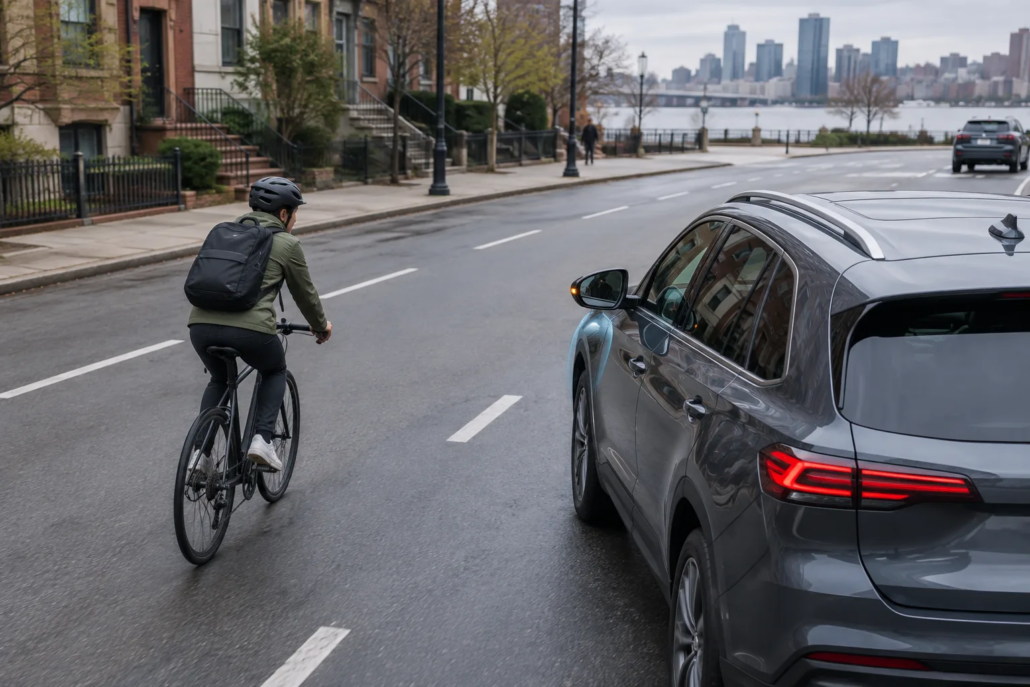
A cyclist rides beside traffic when a vehicle begins turning or moving into the next lane. If the driver says a blind-spot warning did not activate, or the cyclist believes it should have, the collision may raise questions beyond what each person saw. A Boston bicycle crash involving a possible blind-spot warning defect calls for careful attention to both the driver’s conduct and the system’s actual behavior. Neumann can help readers understand how those issues may be evaluated without assuming a warning feature replaces the driver’s responsibility to look and act safely. This article explains what a warning-system failure can—and cannot—show, what evidence may help clarify the issue, and how visibility and fault questions fit into a Massachusetts injury claim.
When a Boston bicycle crash raises a blind-spot warning defect question
A blind-spot monitoring system is designed to alert a driver to certain vehicles or objects detected near the vehicle. Depending on the vehicle, a warning may appear in a mirror, sound an alert, or work alongside another driver-assistance feature. Systems differ, and their detection range or operating conditions may be limited. A cyclist’s position, the vehicle’s speed and direction, sensor placement, weather, and surrounding traffic can all matter when trying to understand what the system could detect.
An absent or late warning does not, by itself, establish that a component was defective. The system may not have been active, may have been affected by its settings or condition, or may have limits that are described in the vehicle materials. Alternatively, an investigation might raise questions about a sensor, installation, design, manufacture, or instructions. In other words, the issue is not simply whether a warning appeared; it is whether the system functioned as intended and whether any problem contributed to the crash.
A warning system does not replace driver attention
Drivers remain responsible for paying attention to surrounding traffic and checking that a lane change or turn can be made safely. A warning feature is an aid, not permission to rely on sensors alone. A claim may therefore involve separate questions about driver conduct and product performance. For a broader explanation of how a vehicle defect may contribute to a Massachusetts injury claim, the key point is that a component issue needs evidence connecting it to the event and resulting harm.
What evidence may clarify a blind-spot warning failure
Evaluating a possible malfunction often requires more than a driver’s recollection or a single dashboard light. The vehicle’s make, model, age, repair history, system settings, sensor condition, and any available diagnostic information may be relevant. Some vehicles may store data about system events; others may not retain a useful record of a warning or sensor detection. The absence of a stored alert is not necessarily proof that a system worked properly or failed.
Potentially useful evidence may include:
- Photographs of the vehicles, bicycle, damage, roadway, and relevant sensor locations.
- The vehicle’s owner and repair records, along with manuals describing system limits.
- Crash reports, witness accounts, and available nearby camera footage.
- Inspection findings and any diagnostic data that can be obtained and interpreted reliably.
For a Boston collision, records may involve the Boston Police Department, MassDOT, nearby businesses, or other sources, depending on the roadway and circumstances. Availability and retention periods can vary. Vehicle repairs, replacement of damaged parts, or changes to system settings may affect later inspection, so preserving the vehicle and documenting its condition can matter. More on preserving a vehicle after a Massachusetts crash explains why the condition of the vehicle may be important to an investigation.
Driver conduct and cyclist visibility remain separate questions
A product investigation does not answer every question about how a collision happened. Investigators may also consider the driver’s speed, attention, signaling, turn or lane-change path, and the time available to notice the cyclist. For the cyclist, roadway position, lighting, clothing visibility, and movement through the intersection or lane may be considered in context. No single detail necessarily determines fault; the full sequence and available evidence matter.
This distinction is important in Boston, where traffic patterns, parked vehicles, intersections, and narrow or changing road space can affect what each road user could see. A crash involving a turning vehicle is not the same as a “dooring” collision, but both may involve disputed visibility and roadway position. Evidence in a Boston cyclist collision involving disputed visibility can help explain how those questions differ, while keeping the focus on the particular crash rather than assuming the causes are identical.
In Massachusetts, responsibility may be assessed among parties under the rules that apply to the case. The driver’s conduct, a possible product issue, and the cyclist’s actions can be considered separately and together. A product claim may involve a manufacturer or another entity in the distribution or repair chain, depending on the facts and applicable law. Identifying a potential claim requires evidence of a relevant defect or other legally recognized basis, a connection to the collision, and legally compensable harm. Massachusetts rules and procedures may change, and the details of an individual claim matter.
Frequently Asked Questions
Does a missing warning prove the blind-spot system was defective?
No. A warning that did not appear may prompt questions, but it does not establish a defect on its own. The system may have operating limits, may not have been active, or may have been affected by its condition or settings. An evaluation may consider the vehicle’s design and history, available technical information, the crash circumstances, and whether a system issue plausibly contributed to the collision.
Can a cyclist pursue a claim if the driver says the system was working?
A driver’s account is one piece of information, not necessarily a complete technical assessment. Other evidence—such as vehicle condition, repair history, witness statements, images, and any available diagnostic information—may help clarify what happened. Whether a claim is available depends on the facts and applicable Massachusetts law. A qualified attorney can assess the evidence and explain possible legal options.
What if the vehicle has already been repaired?
Repairs can make some inspections harder, but they do not automatically resolve whether a claim can be evaluated. Repair invoices, photographs taken before or during repairs, replaced components, and records of diagnostic work may still be informative. The importance of each item depends on what was changed and what other evidence exists. An attorney may be able to assess what information remains available.
Could a cyclist’s visibility affect a product claim?
Visibility may be relevant to understanding how the collision occurred, but it does not automatically answer whether a warning system had a defect. Investigators may examine what the driver could see, what the system could detect, and how each road user moved. Massachusetts law may consider fault among multiple parties, depending on the circumstances. The interaction of these issues calls for a fact-specific review.
How Neumann Can Help
Neumann is dedicated to helping injured cyclists understand the questions that can arise when a vehicle’s warning system may not have performed as expected. A careful review can consider the vehicle’s condition and records alongside driver conduct, visibility, and the circumstances of the Boston crash. The firm is committed to fighting for injured people’s rights and can explain what additional information may be useful, without assuming that a system problem or legal claim has already been established. Contact Neumann to request a free consultation or case evaluation and discuss your situation.
The information in this article is for educational purposes only and does not constitute legal advice. Contact a qualified attorney authorized to practice in the jurisdiction that applies to your matter for advice specific to your situation.

Leave a Reply
Want to join the discussion?Feel free to contribute!