
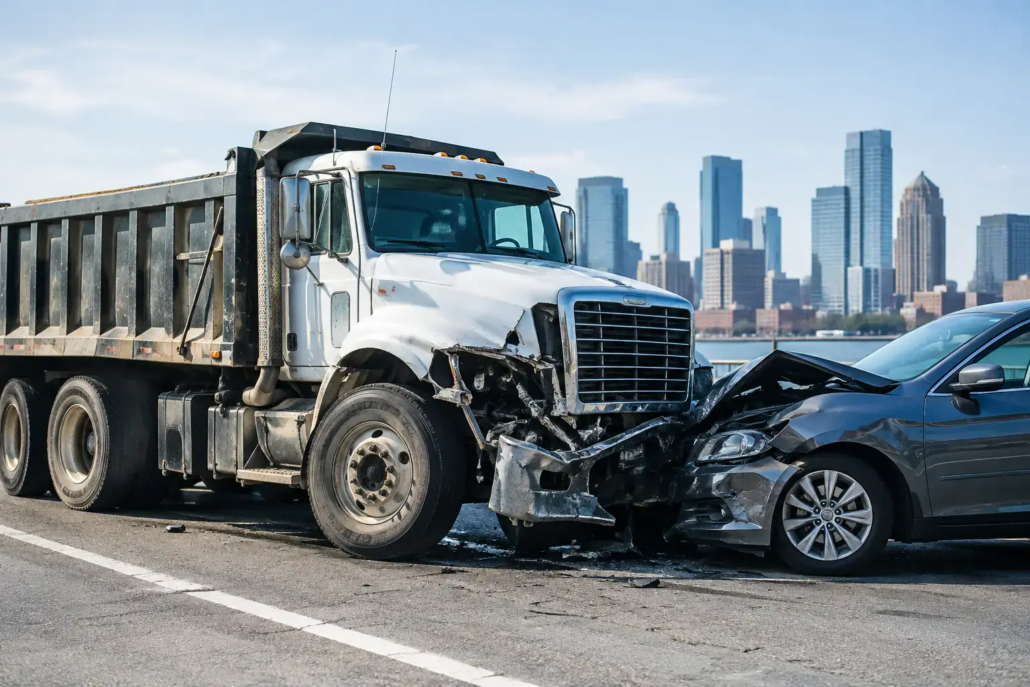
After a Construction Truck Collision in Boston
A construction truck collision can turn an ordinary Massachusetts commute into a medical and financial emergency in seconds. A dump truck merging near a work zone, a concrete mixer turning across traffic, or a flatbed shedding a load can cause far more serious harm than a typical passenger-car crash. The days that follow matter. Your medical care comes first, but the evidence needed to explain what happened may disappear quickly.
Construction trucks are not just larger vehicles. They are often part of a moving network of drivers, contractors, equipment owners, project managers, and insurers. That makes accountability more complicated, but it can also mean that more than one party may bear responsibility for the injuries caused.
Why Construction Truck Collisions Need Immediate Attention
A commercial truck may weigh many times more than a passenger vehicle, particularly when loaded with gravel, asphalt, soil, steel, or equipment. The force involved can leave a driver, passenger, cyclist, or pedestrian with brain injuries, spinal injuries, fractures, internal injuries, or lasting pain that is not fully apparent at the crash scene.
The legal issues are also different. A truck driver may be employed by a construction company, supplied by a staffing business, or working for a subcontractor. The truck itself may be leased or owned by another company. A roadway project can involve public agencies, general contractors, traffic-control providers, and multiple subcontractors. Determining who controlled the truck, the route, the load, and the work area is often central to a claim.
This is why it is risky to accept an early explanation that the crash was simply an unavoidable accident. A truck’s size does not excuse unsafe driving. Massachusetts drivers and companies still have a duty to use reasonable care, maintain vehicles, secure loads, train drivers, and operate safely around roadwork and the public.
What Should You Do After a Construction Truck Collision?
Get emergency care if you are hurt, even if you initially feel able to walk away. Adrenaline can mask symptoms, and prompt medical documentation can connect your injuries to the crash. Follow through with recommended treatment and tell your providers about every symptom, including headaches, dizziness, numbness, sleep disruption, or emotional distress.
If you can do so safely, photograph the vehicles, the truck’s company name and identifying numbers, debris, tire marks, damage, traffic signals, lane markings, and temporary work-zone signs. Get the names and contact information of witnesses. If police respond, ask how to obtain the crash report, but do not assume the report will capture every relevant fact.
Avoid giving a recorded statement to the trucking company’s insurer before you understand the extent of your injuries or the questions being asked. Insurance representatives may sound helpful while seeking statements that minimize pain, shift blame, or lock you into an incomplete account before all the evidence is known.
Keep the damaged vehicle, photographs, medical bills, prescription receipts, missed-work records, and communications from insurers. A short written record of your symptoms and the ways the injury affects work, family responsibilities, sleep, and daily movement can also be meaningful evidence later.
Evidence Can Be Lost Faster Than Many People Expect
Commercial vehicles may carry electronic data that shows speed, braking, steering, engine operation, or hours of use before a collision. A truck may also have dash-camera footage, GPS information, dispatch messages, inspection records, maintenance files, driver qualification records, and load tickets. Nearby businesses, residences, and work sites may have surveillance footage.
Some of this material is routinely overwritten, deleted, repaired, or discarded. The physical truck may return to service. A construction project may move forward, changing lane configurations and removing temporary signage. Early legal action can include asking responsible parties to preserve relevant evidence before it is no longer available.
Who May Be Responsible for a Construction Truck Crash?
The driver is one possible defendant, but rarely the only question. A driver may be liable for speeding, following too closely, backing without proper care, making an unsafe turn, driving while distracted, failing to yield, or operating while fatigued. A driver who ignored a spotter, warning signs, or a required safety procedure may also have contributed to the collision.
The driver’s employer or contracting company may be responsible for its own conduct or for the driver’s actions within the scope of employment. Relevant questions include whether the company screened and trained the driver, enforced reasonable hours, maintained the truck, inspected it, and scheduled deliveries in a way that pressured unsafe driving.
A vehicle owner, leasing company, repair provider, or manufacturer may also be implicated if brake failure, tire failure, lighting problems, steering defects, or another mechanical issue played a role. In a load-related crash, the company that loaded or secured materials may deserve close scrutiny.
Work-zone conditions can create separate issues. Temporary lanes, poorly placed barrels, missing signs, obstructed sightlines, inadequate flagging, and unsafe traffic-control plans can make an already dangerous area worse. Depending on the facts, a contractor, subcontractor, property owner, or public entity could be involved. Claims involving government bodies may have specialized notice requirements and shorter deadlines, so waiting can be especially costly.
Massachusetts Insurance Issues Can Complicate Recovery
Massachusetts is a no-fault insurance state for many initial medical expenses and lost wages. Personal Injury Protection, commonly called PIP, may provide limited benefits regardless of fault. Those benefits are not the same as full compensation for a serious injury.
When an injury meets the legal threshold for a liability claim, an injured person may seek damages from the party or parties at fault. Compensation may include medical expenses, future treatment needs, lost income, reduced earning capacity, pain and suffering, and other losses supported by the evidence. In a fatal crash, surviving family members may have a wrongful death claim.
Commercial policies can carry higher limits than personal auto policies, but a larger policy does not make the process easy. Insurers may dispute fault, argue that a prior condition caused your symptoms, question the necessity of treatment, or point to a worker, another driver, or a road condition as the real cause. When several businesses are involved, each may attempt to place responsibility elsewhere.
If you were working when the crash happened, workers’ compensation may be part of the picture as well. That does not necessarily prevent a claim against a negligent third party, such as a separate trucking company or contractor. The interaction between workers’ compensation benefits and a personal injury claim should be evaluated carefully.
Facts That Often Decide a Construction Truck Collision Claim
The most useful case evidence is specific, not speculative. It may include the truck’s event-data recorder, photographs of vehicle damage, roadway measurements, police reports, witness accounts, phone records, maintenance logs, driver training materials, delivery schedules, project plans, and video from the surrounding area.
Timing matters. Did the truck have a clear line of sight? Was it backing up without an effective spotter? Was the driver entering a congested Boston street during a delivery window that left little room for safe maneuvering? Were cones or lane closures visible and properly positioned? Did the company know of prior mechanical problems? Each answer can change the liability analysis.
Your own conduct may be examined too. Massachusetts follows a modified comparative negligence rule. In general, an injured person can recover damages if they were not more than 50 percent responsible, though their compensation may be reduced by their share of fault. An insurer’s accusation is not a final legal determination. It should be tested against the physical evidence and the full circumstances of the crash.
Do Not Let the Claims Process Rush Your Recovery
A serious crash creates pressure from every direction: medical appointments, missed paychecks, vehicle repairs, calls from insurers, and concern about the future. It is understandable to want a quick answer. But signing a release can end a claim permanently, including claims for treatment or limitations that become clear only later.
A lawyer can investigate the companies involved, preserve evidence, identify available insurance coverage, calculate losses, and handle insurer communications while you focus on treatment. Massachusetts Injury Lawyers can provide a free consultation, is available 24/7, and can travel to injured clients who cannot come to the office.
The most helpful next step is usually a prompt one: protect your health, keep the records you receive, and ask questions before accepting anyone else’s version of what your construction truck collision was worth.

Leave a Reply
Want to join the discussion?Feel free to contribute!