
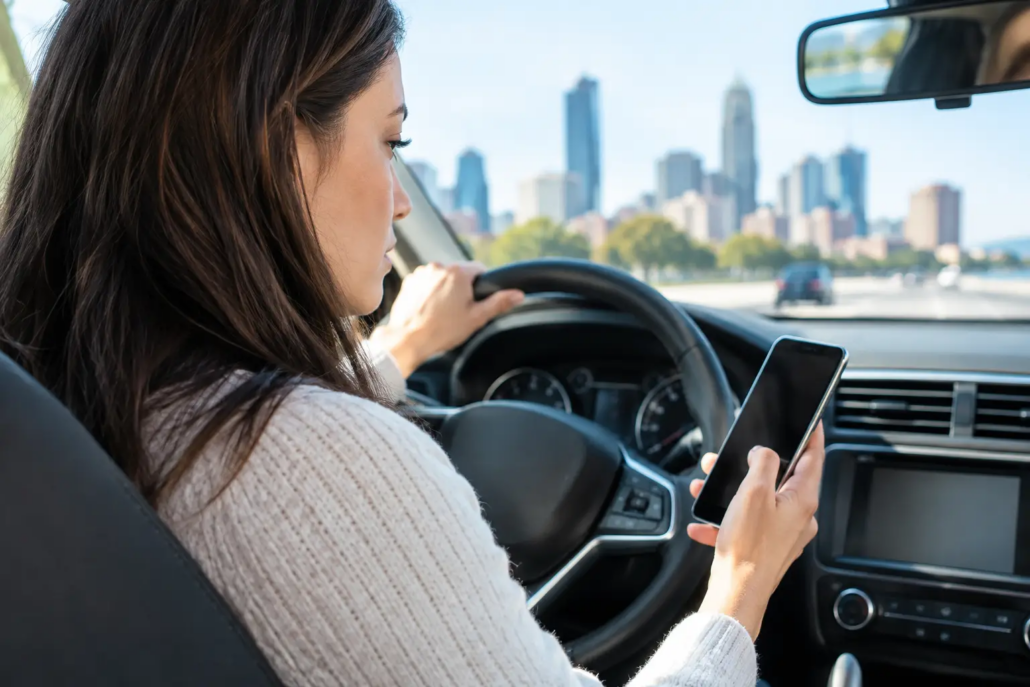
Massachusetts Distracted Driving: What Counts?
A driver looks down for a few seconds at a red light on Commonwealth Avenue, checks a notification while merging onto the Mass Pike, or reaches for a dropped phone in a Boston intersection. The consequences of Massachusetts distracted driving can be severe, particularly when a pedestrian, cyclist, motorcyclist, or occupant of a smaller vehicle has no time or space to avoid the collision.
After a crash, distracted driving is not simply a traffic-safety concern. It may be central evidence of negligence. It can affect how insurers assign fault, whether a claim is disputed, and what compensation an injured person may pursue. The challenge is that distraction often disappears from view once vehicles are moved and drivers begin giving their version of events. Acting promptly to preserve evidence can make a real difference.
What Massachusetts Distracted Driving Law Prohibits
Massachusetts law generally bars drivers from holding or using a mobile electronic device while operating a vehicle, except in limited circumstances such as reporting an emergency. Drivers may use hands-free technology, but hands-free does not give someone permission to drive carelessly. A driver who is speaking through a vehicle system, following navigation prompts, or adjusting a screen can still be distracted enough to cause a preventable crash.
The legal issue after an injury is broader than whether the driver received a ticket. A driver may be negligent if they failed to keep a proper lookout, drifted across a lane, ran a light, followed too closely, failed to yield, or otherwise operated the vehicle without reasonable care. Phone use may explain why that failure occurred, but a distracted-driving claim does not always require proof that a phone was in the driver’s hand.
Distraction also takes forms that have nothing to do with a smartphone. Eating during a commute, reaching into the back seat for a child, programming a navigation system, turning to speak with a passenger, or looking at an in-car display can take a driver’s eyes, hands, or attention from the road. In dense Boston traffic, where vehicles, buses, delivery drivers, cyclists, and people crossing the street share limited space, even a brief lapse can cause life-changing harm.
Why a Citation Is Helpful but Not Required
A citation for unlawful device use can be meaningful evidence, but it is not the only path to showing fault. Police officers often arrive after the impact. They may not have seen what occurred inside either vehicle, and a crash report may record only preliminary observations. A driver may also deny using a phone, even when the physical evidence tells a different story.
Conversely, a citation does not automatically establish every aspect of a civil injury claim. Insurers may still argue that the injured person shared responsibility, that the collision could not have been avoided, or that the injuries were caused by another event. A careful claim examines the full sequence: traffic signals, speed, lane positions, braking, road conditions, witness accounts, vehicle damage, and electronic evidence.
Massachusetts follows a modified comparative negligence rule. An injured person may generally recover damages if their share of fault is not greater than the combined fault of the other responsible parties. Any recovery may be reduced by the percentage of fault assigned to that person. That is why insurance adjusters often focus quickly on statements made at the scene, gaps in medical care, or any conduct they can portray as contributing to the collision.
Evidence That Can Show a Driver Was Distracted
The strongest cases are built from evidence gathered before it is erased, overwritten, repaired, or forgotten. A phone record may show data activity, a call, or a text near the time of impact, although it may not reveal exactly what a driver was doing. In appropriate cases, more detailed phone evidence may be sought through the legal process. The timing must be compared with other proof, including crash-scene evidence and witness testimony.
Vehicle technology can also matter. Many newer vehicles store event data that may record speed, braking, steering, throttle position, and other information in the seconds before a crash. Infotainment systems may contain relevant data as well. This information can be lost if a vehicle is totaled, repaired, sold, or released without a prompt preservation request.
Other useful evidence may include:
- dash-camera, doorbell-camera, traffic-camera, or nearby business surveillance footage;
- photographs of the vehicles, roadway markings, debris, and the final resting positions;
- statements from passengers, other drivers, pedestrians, and first responders;
- employer records when the driver was working, delivering goods, or using a company vehicle; and
- the driver’s social media posts or communications, when lawfully obtained and relevant to the claim.
Not every case requires every type of evidence. A rear-end crash with multiple independent witnesses may be more straightforward than a collision at an uncontrolled intersection with conflicting accounts. Still, early investigation matters because video footage is often overwritten within days, and witnesses become harder to locate as time passes.
What to Do After a Suspected Distracted-Driving Crash
Your health comes first. Accept emergency care when needed, attend follow-up appointments, and tell medical providers about all symptoms, including headaches, dizziness, neck pain, numbness, sleep disruption, or anxiety. Some injuries, including concussions and soft-tissue injuries, may not be fully apparent at the roadside.
If you can do so safely, take photographs and obtain names and contact information for witnesses. Preserve damaged clothing, helmets, child car seats, and personal property rather than discarding them. Keep copies of medical records, bills, work restrictions, receipts, and communications from insurers. A short written account of what you remember can also be valuable, particularly if you record it while the details remain clear.
Be cautious when speaking with the other driver’s insurer. An adjuster may request a recorded statement or seek broad medical authorizations before you understand the scope of your injuries. You can report the claim, but you do not have to guess about fault, minimize your pain, or accept a quick settlement while treatment is ongoing. Early settlement offers may not account for future care, lost earning capacity, or the lasting effect of a serious injury.
When More Than One Party May Be Responsible
The distracted driver is not always the only party whose conduct matters. If the driver was working at the time of the crash, an employer may have responsibility depending on the job duties and the relationship between the company and driver. This can arise in delivery, construction, rideshare, commercial trucking, and sales-related travel cases.
Vehicle ownership, maintenance, road design, defective safety equipment, and the conduct of another driver may also require investigation. A rideshare passenger injured by a distracted driver may face questions about which insurance policy applies. A cyclist struck by a delivery van may need to identify the driver, the company, the vehicle owner, and available commercial coverage. These details affect both liability and the insurance resources available to compensate an injured person.
Protecting Your Claim While You Recover
A serious crash can leave a family managing medical appointments, missed work, vehicle loss, insurance calls, and uncertainty about the future. Evidence of distracted driving can strengthen a claim, but it must be preserved and presented in the context of the entire case. The goal is not merely to prove a driver looked away. It is to show how that preventable choice caused real harm and what support is needed for recovery.
If you or a family member was hurt in a suspected distracted-driving crash, timely legal guidance can help protect evidence before it disappears and keep insurer pressure from dictating the next step. A free consultation can provide a clearer path forward while you focus on healing.


Leave a Reply
Want to join the discussion?Feel free to contribute!