When Could a Boston Truck Attorney Assess Carrier Fault?
A collision involving a commercial truck can leave an injured person wondering whether the driver is the only party who may be responsible. After a Boston truck crash, a Boston truck accident lawyer may examine the carrier’s role as well as the driver’s conduct. The company’s responsibility is not automatic, but its decisions about hiring, vehicle upkeep, cargo, or operating practices may matter if they contributed to the crash. Neumann helps readers understand the issues that can shape an injury claim, including which basic details about the truck, carrier, and collision may be useful. This guide explains when a trucking company may share responsibility, what evidence can help clarify its role, and how multiple parties or deadlines can affect a Massachusetts claim. The facts of each collision differ, and applicable laws can change, so general information cannot determine the outcome of a particular case.
When can a trucking company share responsibility after a Boston crash?
A trucking company is not automatically liable just because its truck was involved in a collision. Responsibility depends on the facts, including who employed or controlled the driver and whether conduct by the company contributed to the crash or resulting injuries. A company may be responsible for an employee’s acts when the employee was acting within the scope of their work. Whether that principle applies can depend on the driver’s status, duties, and the circumstances at the time.
Hiring, driver qualification, and company decisions
A company’s hiring, training, supervision, or driver-qualification decisions may warrant attention if evidence suggests they contributed to a collision. The relevant question is not simply whether the company had a relationship with the driver, but whether its conduct was connected to the harm. For example, information about a company’s knowledge of a driver’s qualifications or work history may be relevant in some cases. A related legal concept is discussed in this guide to Massachusetts negligent-entrustment claims against vehicle owners.
Maintenance, loading, and operating practices
A carrier’s vehicle inspections, maintenance, or repair decisions may matter if a mechanical problem contributed to the crash. Cargo loading can also be relevant when the way freight was secured or distributed affected the truck’s movement or stability. Company practices related to scheduling, supervision, or safety may be examined where they have a factual connection to the collision. These possibilities require evidence; a poor outcome alone does not prove that a company acted improperly. If a component failure is suspected, how failed brakes or tires can support a Massachusetts injury claim helps explain why the source of an equipment problem can matter.
What information may help show a trucking company’s role?
Early details can help identify the carrier and point investigators toward relevant evidence. Depending on the circumstances, useful information may include:
- The truck’s company name, unit number, trailer details, and license plate, if safely observable.
- The driver’s name and employer or carrier information exchanged after the collision.
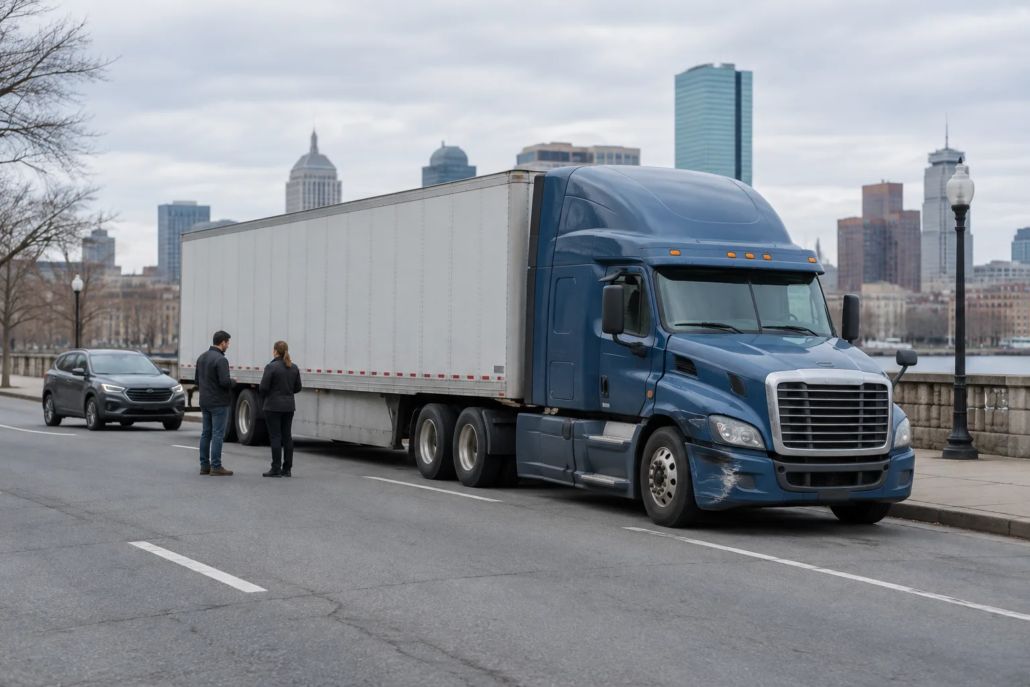
- Photographs of the scene, vehicle positions, visible damage, road conditions, and any cargo or debris.
- Names and contact details for witnesses, along with the date, time, and location of the crash.
- Available incident or police report information and records of communications about the collision.
A lawyer or investigator may also seek records such as inspection and repair documents, driver qualification materials, dispatch information, cargo records, or available electronic data. What exists and what can be obtained depends on the vehicle, company, circumstances, and applicable rules. A damaged truck or component may be important physical evidence, so preserving a damaged vehicle for crash inspection may be relevant when condition or impact damage is disputed. Evidence should be gathered lawfully and safely; people should not enter a restricted crash scene or interfere with an investigation.
For a Boston collision, the responding agency may vary with the location and circumstances. Information may come from Boston Police, Massachusetts State Police, or another agency with responsibility for the scene. A report can help establish basic facts, but it may not answer every question about company practices, vehicle maintenance, or how the collision unfolded.
How can multiple parties and claim steps affect a truck case?
More than one person or organization may have contributed to a collision. Depending on the evidence, potential parties could include a driver, a trucking company, a vehicle owner, a maintenance provider, or another business involved in loading cargo. Their involvement does not itself prove fault. The investigation must connect each party’s conduct to the crash and the claimed harm.
In a multi-vehicle collision, the sequence of impacts and each driver’s actions can affect how responsibility is evaluated. For example, a truck’s initial impact may lead to a second collision, but the surrounding circumstances still need careful review. This is one reason how Boston chain-reaction crashes complicate liability may be useful context when several vehicles are involved.
A claim arising from a Boston crash may proceed in a Massachusetts court with jurisdiction over the parties and type of case; Suffolk County Superior Court may be relevant in some civil matters. The proper venue and procedure depend on the case. Deadlines also depend on the facts and parties, and investigating a company’s role does not necessarily pause them. Readers can review Massachusetts deadlines for filing a Boston motor-vehicle injury claim, while keeping in mind that an attorney can assess how timing rules apply to a specific situation. Massachusetts law and procedures may vary by location and may change over time.
Frequently Asked Questions
Is a trucking company responsible whenever its driver causes a crash?
No. A company’s connection to a driver or truck does not automatically establish responsibility. The facts may show that the driver was acting within the scope of employment, or that the company’s own decisions about maintenance, loading, supervision, or operations contributed to the collision. The driver’s work status and the company’s role may be disputed. A case-specific review is needed to assess which legal principles and evidence may apply.
What if the truck was owned by a different company?
Truck ownership, operation, and employment can involve different businesses. The owner may lease the vehicle to a carrier, while another company may handle maintenance or cargo. Ownership alone does not establish liability, and a carrier’s involvement does not necessarily make it the owner. Identifying the names and roles shown on available truck or carrier information can help clarify which parties may need further investigation.
Can a trucking company’s records be obtained after a crash?
Potentially, but access depends on the records, the circumstances, and the stage of a claim or legal proceeding. Relevant materials might include maintenance, inspection, dispatch, driver qualification, or cargo records. Some information may be held by the carrier or another business, and not every record will be relevant or available. An attorney can explain what methods may apply to request or preserve specific evidence in a Massachusetts matter.
What if I am unsure which company operated the truck?
It is common for a crash scene to leave questions about the carrier, owner, or other businesses involved. Details such as the truck’s identifying information, trailer, driver, and any exchanged insurance or company information may help clarify the vehicle’s connection. A crash report or witness account may also offer leads. If information is incomplete, an attorney may be able to evaluate what sources could help identify the responsible parties.
How Neumann Can Help
Neumann is dedicated to helping injured people understand the issues that can arise after a commercial truck collision. A review may consider the driver’s relationship with the carrier, vehicle and cargo evidence, available company records, and whether more than one party’s conduct may have contributed. The relevant facts and Massachusetts rules can vary, so no general article can determine responsibility in an individual case. If you were hurt in a Boston truck crash, contact Neumann to request a consultation or case evaluation and discuss what information may be useful to assess your options.
The information in this article is for educational purposes only and does not constitute legal advice. Contact a qualified attorney licensed to practice in Massachusetts for advice specific to your situation.

Leave a Reply
Want to join the discussion?Feel free to contribute!