
How Might Phone Data Support a MA Distracted-Driving Claim?
A driver may say a phone was never in use. A witness may remember seeing a screen, but not the exact moment of the collision. In Boston, proving distracted driving after a crash often requires assembling several pieces of evidence rather than relying on one phone record. If you are unsure what to preserve, a free Massachusetts personal injury consultation may help you understand the evidence available and the questions that need investigation.
This article explains what phone records, app activity, screenshots, witness information, admissions, surveillance, police records, and vehicle data may show. It also discusses what these materials may not establish, why timing matters, and why accessing another person’s device or account can create privacy and legal problems. Neumann offers guidance on evaluating these issues without assuming that an allegation of phone use automatically proves negligence.
What Phone Evidence Can Show About Distracted Driving in Massachusetts
Phone evidence may help establish that a device was active around the time of a collision. Depending on what is lawfully obtained and preserved, relevant information may include call records, text-message timestamps, data-session information, application activity, screen interactions, navigation use, or Bluetooth connections. Carrier records may show communications or data activity, but they generally do not explain exactly what a driver was doing, where the phone was located, or whether the driver—not a passenger—used it.
Activity is not the same as causation
A timestamp close to a crash can support an investigation, but it is not automatically proof that phone use caused the impact. A claim still generally requires evidence connecting the driver’s conduct to a failure of reasonable care and to the collision. Massachusetts standards for determining car-accident fault can help explain why timing, road conditions, vehicle movements, and witness testimony must be considered together.
Hands-free activity presents a similar issue. A call, voice command, navigation instruction, or Bluetooth connection may show that a device was engaged, but it may not establish that the driver’s attention was materially diverted. The strength of the evidence depends on context, accuracy, and corroboration.
How to Preserve Distracted-Driving Evidence After a Boston Crash
Evidence can disappear quickly. Messages may be deleted, surveillance systems may overwrite recordings, and witnesses may forget details or become difficult to locate. As soon as reasonably possible, an injured person can record what they remember and preserve materials already in their possession without altering them. Guidance about what to do immediately after a Massachusetts car accident can also help with reporting, medical documentation, witness information, and other early steps.
- Witness names and contact information, along with what each person actually observed.
- Statements made by the other driver, including an admission about texting, calling, checking an app, or looking down.
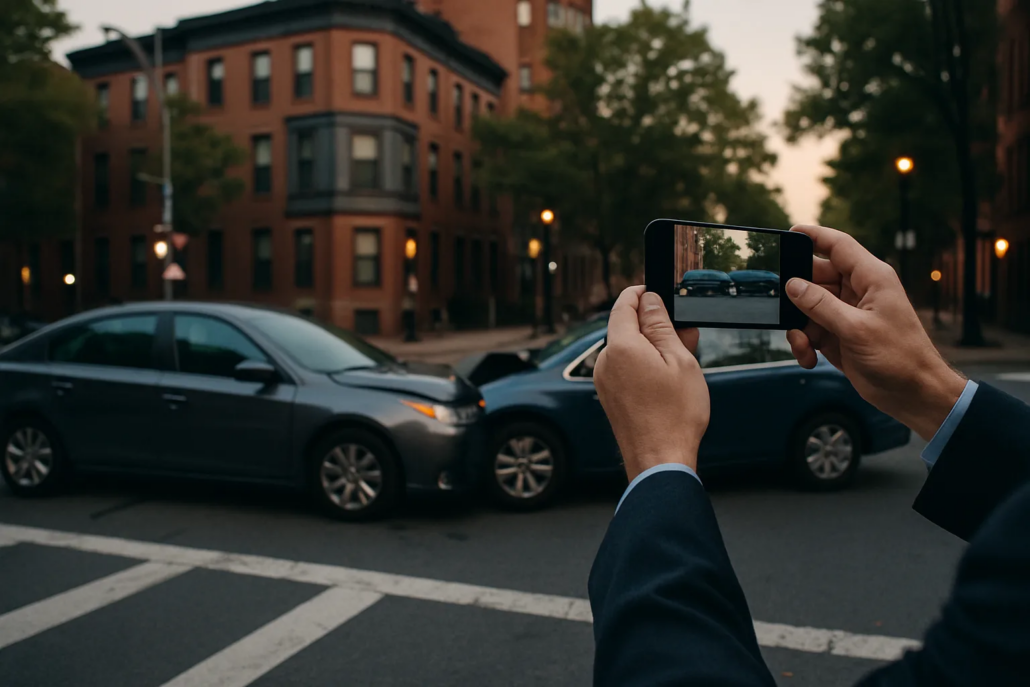
- Photographs or videos from the scene, vehicles, traffic signals, roadway, and visible cameras.
- Screenshots, messages, call logs, or photographs already lawfully available to you.
- The responding police agency, report number, officer information, and any incident materials you receive.
- Nearby businesses, residences, transit areas, traffic cameras, dashcams, or rideshare vehicles that may have captured the collision.
Do not guess, edit, crop away useful context, or create a screenshot that changes the appearance of a message. Do not log into another person’s account, take their phone, bypass a password, or ask someone to provide private records without authorization. An attorney may be able to pursue appropriate requests, subpoenas, or other lawful discovery depending on the case and jurisdiction.
Evidence beyond the phone
Phone activity should be compared with physical evidence. Preserving the damaged vehicle after a Boston crash may help protect photographs, damage patterns, onboard information, or other evidence that can corroborate the sequence of events. Vehicle black-box evidence about speed and braking may also help show what the vehicle did, although it usually does not prove what was displayed on a phone.
How Witnesses, Cameras, and Police Records Strengthen a Phone-Evidence Claim
A distracted-driving investigation is often strongest when independent sources point to the same timeline. A passenger, pedestrian, cyclist, or driver in a nearby vehicle may describe where the other driver was looking, whether the vehicle drifted, whether braking began late, or whether the driver held a device. Witnesses should be asked to describe observations rather than conclusions. For example, “the driver looked down and held a glowing rectangle” is more useful than simply stating that the driver was negligent.
Surveillance may provide another perspective. In Boston, potential sources can include nearby storefronts, parking facilities, residences, traffic-control areas, buses, and dashcams. Readers dealing with a collision may find information about preserving Boston surveillance and witness evidence useful because prompt identification of cameras may matter before recordings are overwritten.
Police records may contain the officer’s observations, driver statements, witness accounts, roadway conditions, citations, diagrams, and information about whether a phone was visible or voluntarily discussed. A police report is important evidence, but it is not always the final word on civil liability. It may omit later-discovered video, medical evidence, or details that were unavailable at the scene.
Rideshare collisions can create additional records, including trip timing, driver status, platform communications, and insurance information. Someone involved in that type of crash may wish to consult a Boston rideshare accident lawyer about lawful ways to identify and request relevant records. Platform information should be obtained through proper channels, never through unauthorized account access.
Frequently Asked Questions
Can phone records prove a Massachusetts driver was texting at the moment of a crash?
Phone records may show calls, messages, data use, or other activity near the time of a collision, but they may not establish who was using the phone or exactly what the driver was doing. Texting while driving evidence in Massachusetts is usually evaluated with witness statements, admissions, video, vehicle movement, and other facts. The records may support an argument about distraction, but they do not automatically prove causation or legal responsibility.
What if the other driver refuses to share phone records?
A person generally should not try to obtain another driver’s private records independently or access the driver’s device or account. Depending on the circumstances, an attorney may evaluate formal information requests, preservation demands, subpoenas, or discovery in a civil case. The available process can depend on the type of record, the procedural posture, privacy concerns, and Massachusetts law. Early advice may help prevent accidental alteration or loss of relevant evidence.
Do screenshots help with a phone records car accident claim?
Screenshots can preserve information that is already lawfully available to the person who took them, such as a message or call history. Their value depends on authenticity, timing, completeness, and whether the information can be corroborated. Readers should preserve the original device or account context when possible and avoid editing images. A screenshot alone may not establish who held the phone, whether the vehicle was moving, or whether the activity caused the crash.
Can vehicle data matter if there is no direct cell phone evidence?
Yes. Braking, speed, steering, impact location, traffic-camera footage, witness accounts, and other physical evidence may help reconstruct what happened even when direct phone evidence is unavailable. This can be especially important when a driver denies phone use or records cannot be obtained. Evidence should be assessed as a whole; no single source necessarily proves or disproves distraction. A lawyer may evaluate whether preserving the vehicle and related electronic data is appropriate.
How Neumann Can Help
Neumann is dedicated to helping injured people examine the evidence surrounding Massachusetts motor vehicle collisions. The firm can evaluate potential phone activity alongside witness information, admissions, surveillance leads, police records, vehicle evidence, and the facts needed to connect conduct with harm. For readers considering a claim, information about Massachusetts standards for determining car-accident fault may provide useful background.
Neumann is committed to fighting for clients’ rights while explaining the limits and strengths of available proof. Contact the firm for a free consultation or case evaluation to discuss what evidence may be relevant to your Boston collision.
The information in this article is for educational purposes only and does not constitute legal advice. Contact a qualified attorney licensed in Boston for advice specific to your situation.

Leave a Reply
Want to join the discussion?Feel free to contribute!