
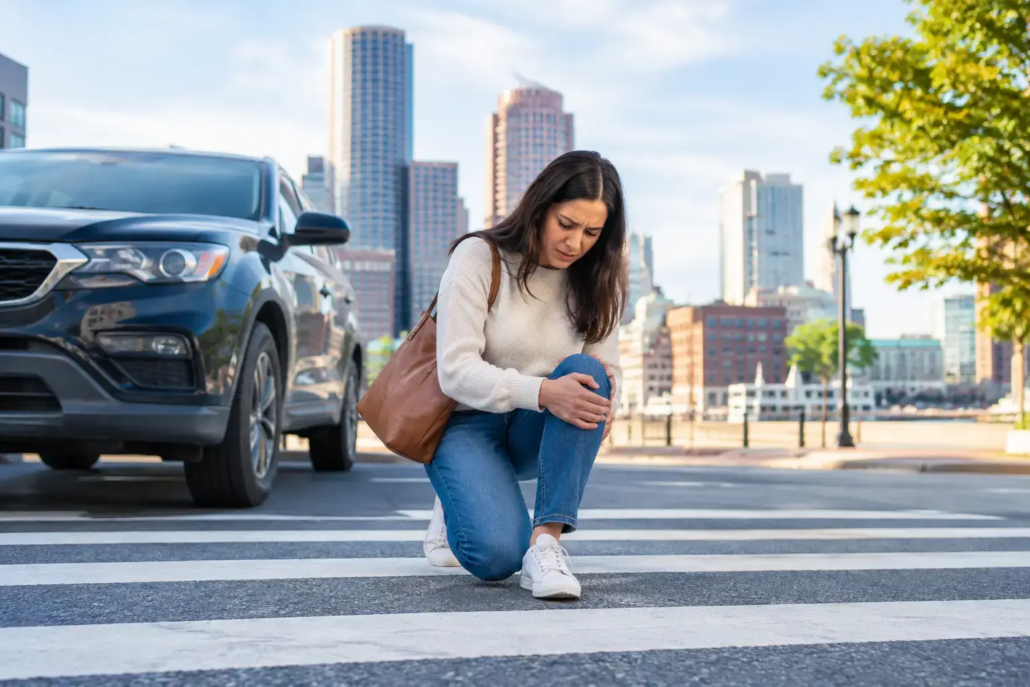
Boston Crosswalk Injury Case Study Explained
A marked crosswalk can feel like the safest place to cross a Boston street. But after a driver strikes a pedestrian there, the legal question is rarely as simple as, “Was there a crosswalk?” This Boston crosswalk injury case study uses a realistic composite scenario to show the facts that can shape an injury claim, the evidence that can disappear quickly, and the insurance issues an injured person may face.
The Crash: A Pedestrian Hit in a Marked Crosswalk
Consider a commuter leaving work near a busy Boston intersection just after sunset. The pedestrian waits for the walk signal, enters a marked crosswalk, and is hit by a driver turning right. The driver tells police that the pedestrian “came out of nowhere.” The pedestrian suffers a fractured wrist, a knee injury, and a concussion that causes headaches and missed time from work.
At first glance, the case may appear straightforward. A driver who turns through a crosswalk must watch for pedestrians lawfully crossing the roadway. Still, the driver’s insurer may look for reasons to reduce or deny responsibility. It may argue that the pedestrian was distracted, crossed against the signal, wore dark clothing, or stepped into traffic too suddenly for the driver to react.
Those arguments make early evidence preservation critical. In Boston, the difference between a strong claim and a disputed one may be found in a traffic camera, a storefront video, a rideshare vehicle’s dash camera, or the timing sequence of a pedestrian signal.
What Must Be Proven After a Boston Crosswalk Injury
The central issue is negligence. In practical terms, the injured pedestrian must show that another party failed to use reasonable care and that this failure caused measurable harm.
For the driver, reasonable care includes maintaining a proper lookout, obeying traffic signals, yielding when required, traveling at a safe speed, and avoiding distractions. A right turn can be especially dangerous because a driver may focus on gaps in vehicle traffic while failing to check the crosswalk to the right.
The pedestrian’s conduct can matter as well. Massachusetts uses a modified comparative negligence rule. An injured person may still recover damages if they share some fault, but their recovery can be reduced by their percentage of fault. A person found more than 50 percent responsible generally cannot recover from the other negligent party.
That does not mean an insurer’s accusation decides the case. A claim should be evaluated through objective evidence, not a rushed statement from a driver or an adjuster’s assumptions about what happened.
The Signal and Intersection Design Matter
In this case study, the walk signal was illuminated when the pedestrian entered the roadway. If confirmed, that fact strongly supports the pedestrian’s account. But the timing matters. Did the signal begin flashing before impact? How long was the pedestrian countdown? Did the driver have a green arrow, a green light without an arrow, or a red light?
The intersection itself may also deserve scrutiny. Construction barriers, a stopped delivery truck, poor lighting, faded markings, or a malfunctioning signal can affect visibility and liability. If unsafe property conditions or roadway work contributed to the crash, responsibility may extend beyond the driver. Claims involving public entities, contractors, or property owners can involve special notice requirements and short deadlines, so waiting can create avoidable problems.
Evidence That Can Change the Outcome
The police report is a useful starting point, but it is not the final word. Officers often arrive after the collision, and their report may rely on statements from people who were stressed, injured, or trying to protect themselves from blame.
A careful investigation in a Boston crosswalk injury case should seek evidence before it is overwritten or lost. That can include surveillance footage from nearby businesses, residential buildings, transit locations, or parking facilities. It may include photos showing the crosswalk’s condition, tire marks, debris, vehicle damage, street lighting, and the pedestrian’s location after impact.
Witness information is equally valuable. An independent witness who saw the walk signal, the driver looking away, or the vehicle rolling through a turn can provide context that neither party’s initial statement captures. Witness memories fade, and video systems commonly record over footage within days or weeks.
Electronic evidence may matter too. A vehicle’s event data recorder can sometimes provide information about speed, braking, or steering in the seconds before a crash. If the driver was working for a delivery company, operating a rideshare vehicle, or driving a commercial vehicle, company records and app data may help establish who was responsible and what insurance coverage applies.
The Injuries Are Part of the Case, Not an Afterthought
A crosswalk collision can cause more than visible fractures. Pedestrians have no vehicle frame, seat belt, or airbag to absorb the force. A person may experience concussion symptoms, neck and back pain, torn ligaments, nerve damage, anxiety around traffic, or worsening pain that does not become clear until days later.
In the composite case, the fractured wrist requires surgery and physical therapy. The knee injury makes stair climbing and commuting difficult. The concussion interferes with concentration at work. These effects should be documented through medical records, treatment recommendations, prescriptions, therapy notes, and proof of missed income.
Insurance companies may question gaps in treatment or argue that pain came from a preexisting condition. A prior injury does not excuse a driver from causing new harm or aggravating an existing condition. Clear medical documentation helps distinguish the condition before the crash from the limitations that followed it.
Insurance Coverage May Be More Complicated Than Expected
Massachusetts auto insurance includes personal injury protection, often called PIP. Depending on the circumstances and available health insurance, PIP may help with certain medical expenses and lost wages regardless of fault. It is usually an early source of benefits, not a complete answer for a seriously injured pedestrian.
The at-fault driver’s bodily injury coverage may provide compensation for medical costs, lost income, pain and suffering, and other damages. Yet minimum coverage can be inadequate when injuries are significant. A full review may need to consider whether the driver was using a personal vehicle for work, whether an employer is responsible, whether a rideshare policy applies, and whether the injured pedestrian has uninsured or underinsured motorist coverage through their own household auto policy.
The driver may also claim that another vehicle forced the turn or blocked visibility. If an unidentified vehicle played a role, uninsured motorist coverage may become particularly important. These coverage questions are fact-specific, and early statements to insurers should be handled carefully. A pedestrian should not feel pressured to estimate recovery time, accept blame, or agree to a quick settlement before the extent of the injuries is known.
What the Case Study Shows About Timing
The strongest point in this scenario is not simply that the crash occurred in a painted crosswalk. It is that multiple pieces of evidence support a clear sequence: the pedestrian had the walk signal, the driver turned without yielding, video confirms the vehicle’s path, and medical records connect the collision to documented injuries and work limitations.
The trade-off is that not every case has video or neutral witnesses. When evidence is limited, the physical scene, damage patterns, signal records, prompt medical care, and consistent accounts become even more important. A claim can still be valid without perfect proof, but it requires disciplined investigation rather than assumptions.
After a pedestrian crash, medical care comes first. If possible, preserve photos, names, clothing, and paperwork, and avoid repairing or discarding damaged personal items until they have been documented. A prompt legal review can help identify evidence, insurance policies, and deadlines while the injured person focuses on recovery.
For people hurt at a Boston intersection, accountability often begins with asking the right questions early. Massachusetts Injury Lawyers can review a crosswalk crash during a free consultation and remain available 24/7 when an injured pedestrian or family needs clear guidance.

Leave a Reply
Want to join the discussion?Feel free to contribute!